HubSpot vs Marketo vs ActiveCampaign vs Pardot: Which Marketing Automation Platform is Right for Your Business?
Compare HubSpot, Marketo, ActiveCampaign, and Pardot marketing automation platforms. Real pricing, feature breakdowns, and decision frameworks for 2026.
Choosing the right marketing automation platform can transform how your team generates leads, nurtures prospects, and drives revenue. But with dozens of options claiming to be "the best," how do you cut through the noise?
We've compared four leading platforms—HubSpot, Marketo Engage, ActiveCampaign, and Pardot (now Marketing Cloud Account Engagement)—across the criteria that actually matter: ease of use, feature depth, integration capabilities, pricing, and real-world performance for different business contexts.
The Detailed Breakdown
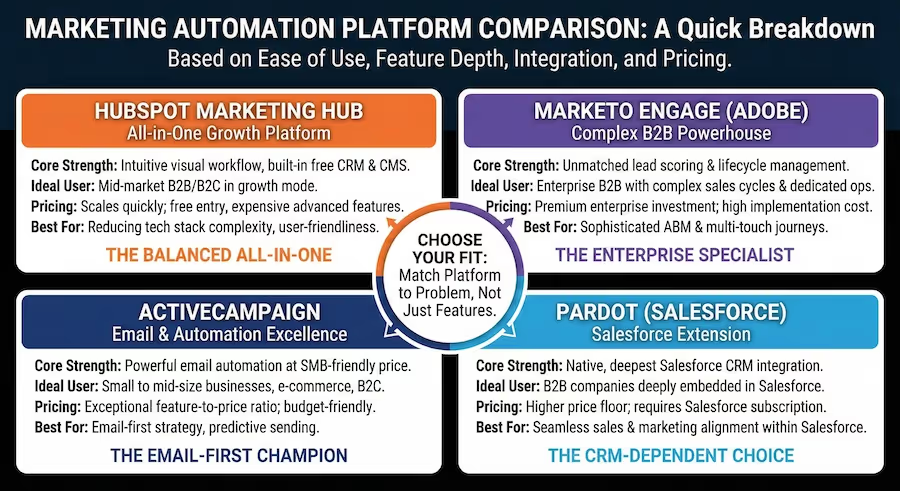
HubSpot Marketing Hub
What makes it different: HubSpot pioneered the "growth platform" approach, bundling marketing, sales, and service tools into one ecosystem. This isn't just marketing automation—it's a complete GTM stack.
Core strengths:
- Intuitive visual workflow builder that non-technical marketers can actually use without extensive training
- Built-in CRM that's genuinely free and surprisingly capable, eliminating integration headaches
- Content management system included, so you can build landing pages, blogs, and entire websites without switching platforms
- Strong analytics that connect marketing activities directly to revenue, not just vanity metrics
Where it falls short:
- Advanced features (custom reporting, predictive lead scoring, multi-touch attribution) are locked behind expensive Enterprise tier
- Email deliverability can be inconsistent compared to dedicated email platforms
- Pricing scales quickly as contact lists grow, which can shock teams unprepared for the cost curve
Ideal user: Mid-market B2B or B2C companies (20-200 employees) that want an integrated platform and are willing to pay for simplicity. Especially strong if you don't already have a CRM or need to replace a fragmented tech stack.
Deal-breaker scenarios: If you already have Salesforce deeply embedded in your operations, or if you need enterprise-grade segmentation with 50+ data points, HubSpot may feel limiting.
Marketo Engage (Adobe)
What makes it different: Marketo is the most technically sophisticated platform on this list. It's built for complex, multi-touch B2B journeys where a single lead might interact with your brand 20+ times before converting.
Core strengths:
- Unmatched lead scoring and lifecycle management—you can build scoring models with hundreds of behavioral and demographic signals
- Advanced segmentation that can handle nuanced audience definitions (e.g., "enterprise contacts who attended two webinars, downloaded three whitepapers, and work in financial services")
- Robust ABM capabilities, including account-level tracking and engagement programs
- Best-in-class program templates and scalability for running hundreds of campaigns simultaneously
Where it falls short:
- Steep learning curve—expect 3-6 months before your team is truly proficient
- Reporting interface feels dated compared to modern SaaS products
- Requires significant implementation effort and often demands a dedicated Marketo admin
- Landing page builder lags behind competitors in design flexibility
Ideal user: Enterprise B2B companies (500+ employees) with complex sales cycles, established marketing ops teams, and the budget to support Adobe's ecosystem. Works best when paired with Salesforce or Microsoft Dynamics.
Deal-breaker scenarios: If your marketing team is small (fewer than 3 dedicated members) or lacks technical skills, Marketo will overwhelm you. Also avoid if you need strong e-commerce or B2C capabilities.
ActiveCampaign
What makes it different: ActiveCampaign started as an email marketing platform and evolved into full marketing automation. That email-first DNA shows—its email capabilities outshine platforms that cost 5x more.
Core strengths:
- Incredibly powerful email automation at SMB-friendly pricing—you get features typically reserved for enterprise tools
- Predictive sending and content optimization that actually move the needle on open rates
- Visual automation builder that's more flexible than HubSpot's while remaining approachable
- Strong integration marketplace, especially for e-commerce platforms (Shopify, WooCommerce)
- Generous contact limits compared to competitors at similar price points
Where it falls short:
- Landing page builder is functional but basic—you'll likely need a separate tool for sophisticated pages
- No built-in CRM (though they offer a basic one); most teams use it alongside another system
- Limited ABM and account-based features make it less suitable for enterprise B2B
- Reporting is solid for email but less comprehensive for full-funnel attribution
Ideal user: Small to mid-size businesses (5-50 employees) focused heavily on email marketing, e-commerce brands, B2C companies, or service businesses with straightforward nurture sequences.
Deal-breaker scenarios: If you need sophisticated multi-channel attribution, ABM capabilities, or manage complex B2B sales cycles with 6+ month timelines, you'll outgrow ActiveCampaign's capabilities.
Pardot (Salesforce Marketing Cloud Account Engagement)
What makes it different: If Salesforce is your single source of truth, Pardot offers the tightest possible integration with your CRM. It's essentially an extension of Salesforce, not a separate platform.
Core strengths:
- Native Salesforce integration means zero data sync issues—every interaction flows instantly between systems
- Engagement Studio provides sophisticated drip campaign logic for complex B2B journeys
- Powerful lead grading (fit) and scoring (interest) system that combines demographic and behavioral signals
- Strong form and landing page capabilities with Salesforce data pre-population
- Einstein AI features for lead scoring and send-time optimization (at higher tiers)
Where it falls short:
- Essentially useless if you're not on Salesforce—the entire value proposition assumes deep Salesforce dependency
- User interface feels clunky and dated compared to modern tools like HubSpot
- Reporting lives in Salesforce, which means you need Salesforce expertise to create meaningful dashboards
- Higher price floor than competitors makes it expensive for smaller teams
Ideal user: Mid-market to enterprise B2B companies already committed to Salesforce, especially those with established sales ops teams who can leverage the deep integration.
Deal-breaker scenarios: If you're not on Salesforce or considering switching CRMs in the next 2-3 years, don't choose Pardot. Also avoid if your marketing team lacks technical skills or Salesforce expertise.
Head-to-Head: Key Decision Factors
Ease of Use & Time to Value
Winner: ActiveCampaign → Most teams are running campaigns within a week. HubSpot comes in second.
Honorable mention: HubSpot → Slightly more complex but still accessible.
Requires investment: Marketo, Pardot → Plan for months of setup and training.
Email Marketing Capabilities
Winner: ActiveCampaign → Purpose-built for email excellence. Deliverability, automation depth, and AI features are top-tier.
Strong alternative: HubSpot → Great for most use cases, though email purists may notice limitations.
Functional but not stellar: Marketo, Pardot → Email is one feature among many, not the main focus.
Integration Ecosystem
Winner: HubSpot → 1,500+ native integrations and a robust API. The all-in-one approach means less integration need.
Close second: ActiveCampaign → Excellent coverage for e-commerce and SMB tools.
Enterprise-focused: Marketo, Pardot → Deep integrations with enterprise systems (Salesforce, Microsoft, Adobe) but fewer SMB-focused connections.
Lead Scoring & Intelligence
Winner: Marketo → The most sophisticated scoring and lifecycle management available.
Strong alternative: Pardot → Excellent lead grading and scoring, especially when combined with Salesforce data.
Good enough for most: HubSpot → Predictive lead scoring at Enterprise tier is solid. Active Campaign offers basic scoring.
Reporting & Analytics
Winner: HubSpot → Clean dashboards, revenue attribution, and insights that non-analysts can understand.
Enterprise depth: Marketo → Powerful but requires expertise to configure properly.
CRM-dependent: Pardot → Great if you're skilled in Salesforce reporting, frustrating otherwise.
Basic but sufficient: ActiveCampaign → Strong email analytics, but limited full-funnel visibility.
Pricing & Value
Winner: ActiveCampaign → Exceptional feature-to-price ratio for small to mid-size businesses.
Premium but justified: HubSpot → Higher cost, but the all-in-one convenience can eliminate other tool expenses.
Enterprise investment: Marketo, Pardot → Premium pricing that makes sense at scale but prohibitive for smaller teams.
Making Your Decision: A Framework
Choose HubSpot if:
- You want an all-in-one platform that reduces tech stack complexity
- Your team values user-friendliness and wants quick time-to-value
- You need marketing, sales, and service tools that work seamlessly together
- You're a B2B or B2C company in growth mode (not early startup, not enterprise)
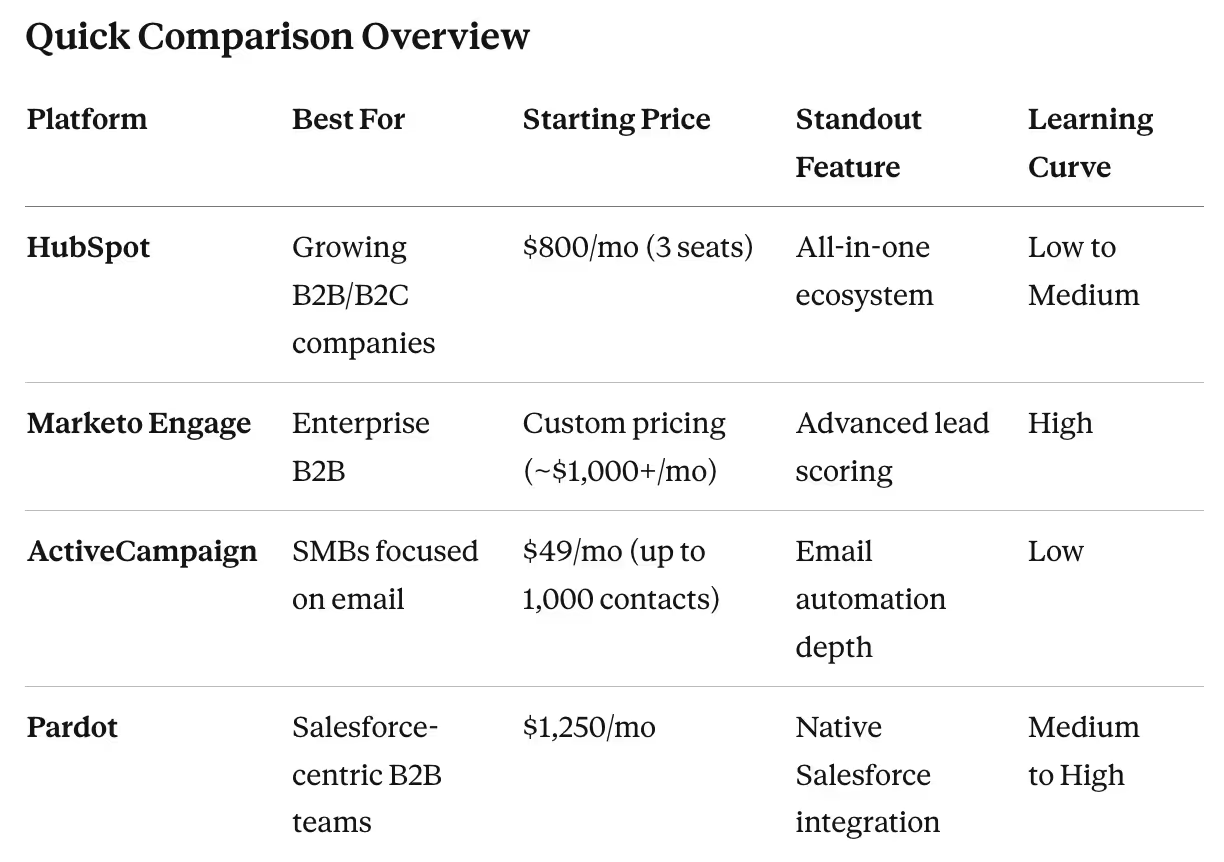
- Budget allows for $1,000-3,000/month once you scale
Choose Marketo if:
- You're an enterprise B2B organization with complex sales cycles
- You have (or can hire) dedicated marketing operations talent
- Advanced lead management and ABM are strategic priorities
- You're already in the Adobe or Salesforce ecosystem
- Budget allows for $2,000-5,000+/month with implementation costs
Choose ActiveCampaign if:
- Email marketing is your primary lead generation channel
- You're a small business or startup watching every dollar
- You operate in e-commerce, B2C, or have straightforward nurture sequences
- Your team is small (1-5 marketers) and needs something they can self-implement
- Budget is under $500/month
Choose Pardot if:
- Salesforce is non-negotiable and deeply embedded in your operations
- You're a B2B company with established sales and marketing alignment
- You want data to live in a single system (Salesforce) without syncing complications
- Your team has Salesforce expertise or can develop it
- Budget allows for $1,500-4,000/month
The Real Question: What Problem Are You Solving?
Most companies approach this decision by listing features they think they need. The better approach: identify the pain you're trying to solve.
If your problem is: "Our marketing and sales teams use 8 different tools and nothing talks to each other"
Consider: HubSpot (all-in-one approach) or Pardot (if already on Salesforce)
If your problem is: "We generate leads but can't identify which ones are actually sales-ready"
Consider: Marketo (sophisticated scoring) or Pardot (tight CRM integration)
If your problem is: "Our email open rates are declining and we're not effectively nurturing leads"
Consider: ActiveCampaign (email excellence) or HubSpot (good email + broader capabilities)
If your problem is: "We're running ABM programs but can't track account-level engagement"
Consider: Marketo (purpose-built ABM) or Pardot (with Salesforce account structure)
There's no universal "best" marketing automation platform—only the best fit for your specific context. HubSpot offers the most balanced combination of power and usability for the majority of mid-market companies. Marketo remains unmatched for complex enterprise B2B scenarios where sophistication matters more than ease of use. ActiveCampaign delivers exceptional value for budget-conscious teams focused on email. And Pardot is the obvious choice if Salesforce is your system of record and you value seamless integration above all else.
Before committing, take advantage of free trials and demand deep product demos focused on your specific use cases. The platform you choose will shape your marketing operations for years, so invest the time to get it right.
Pro tip: Whatever you choose, remember that the platform is only as good as the strategy and execution behind it. Even the most sophisticated tool won't fix broken processes or unclear messaging. Start with strategy, then select the technology that best enables it.
📋 About This Guide
This comprehensive guide is based on research and analysis of official platform documentation, verified user reviews, industry benchmarks, and publicly available information (verified January 2026).
Learn more: Read our complete research methodology to understand how we evaluate software tools.
Content Verification: All information in this guide was verified as accurate in January 2026. Platform features, pricing, and offerings are subject to change. We recommend verifying current details directly with vendors before making purchasing decisions.