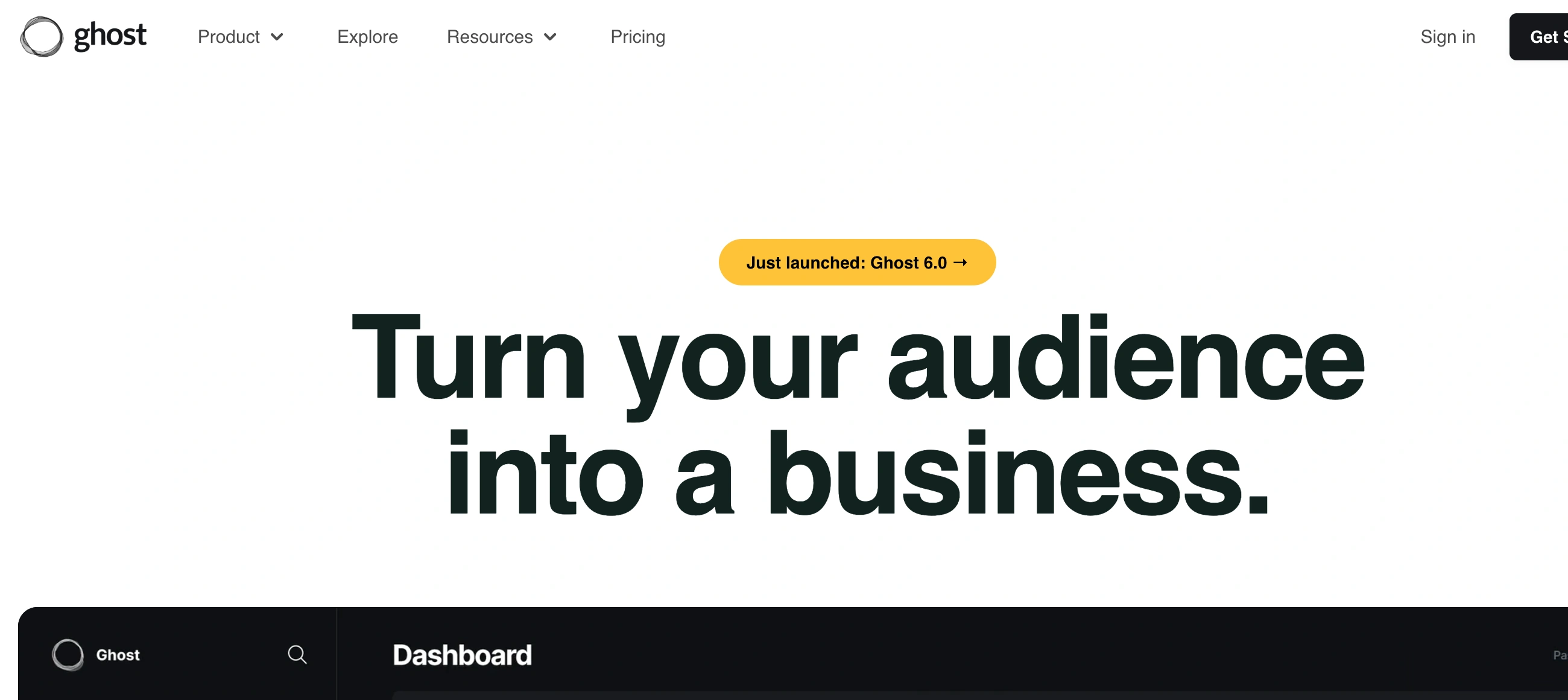
✨ Is Ghost Right for You?
What it is: An open-source publishing platform built specifically for newsletters and memberships, with managed hosting starting around entry-level pricing or self-hosted options if you've got genuine technical skills.
Best for: Professional publishers building subscription businesses, independent journalists monetizing their audiences, content creators producing membership sites, and bloggers serious about owning their platform long-term instead of renting space on someone else's infrastructure.
Main limitation: No plugin ecosystem like WordPress means customization requires actual coding knowledge. Support quality varies—response times and expertise levels fluctuate depending on who handles your ticket. The July 2025 pricing restructure pushed some monetization features to higher tiers.
Get it if: You're building a serious publishing business where economics matter more than feature abundance. Ghost charges zero platform fees, which means you keep your entire subscription revenue minus only payment processing. At scale, this difference becomes thousands in your pocket versus someone else's.
Skip it if: You need extensive e-commerce capabilities beyond memberships, want algorithmic discovery like Medium offers to find new readers, require WordPress-level customization through one-click plugins, or need hands-on support responding immediately to every question.
🎯 Why Ghost?
Platform fees are bleeding your revenue—every month, 10% of what your readers pay disappears to someone else before you even see it. Ghost flips this completely. You own everything, keep everything, control everything. Publishers doing $60K annually save thousands compared to percentage-based platforms, and that difference compounds every single year.
⚡ Performance That Actually Matters
Ghost sites load in under 600ms while WordPress equivalents often take 3-4 seconds. Independent testing shows Ghost running up to 1,900% faster thanks to Node.js architecture that handles more traffic with less hardware. This translates to better SEO, happier readers, and conversion rates that actually stick.
💰 Economics That Scale With You
Substack takes 10% of all paid subscriptions forever, which means at $5K monthly recurring revenue, that's $500 gone every single month—$6,000 annually just sitting in their pocket instead of yours. Ghost charges zero platform fees. You pay for hosting and keep the rest. The difference compounds brutally as you grow because Ghost's costs stay relatively flat while percentage-based platforms eat more of your revenue month after month.
🌍 Enterprise Companies Trust It
Apple, Mozilla, DuckDuckGo, Cloudflare, and OpenAI run their content on Ghost. That's not marketing fluff—these companies chose Ghost after evaluating every alternative because the platform actually performs at scale. If it handles enterprise publishing loads, it'll handle yours.

✎ What You Can Actually Expect
Your Economics Improve Dramatically
If you're currently on Substack doing $5K monthly, you're losing $500 every single month to platform fees before you even see that money. That's $6,000 annually just gone. Ghost keeps that money in your pocket minus only payment processing fees. At $60K annual revenue, the difference becomes $6,000+ yearly—enough to hire help, invest in growth, or simply bank as profit. This compounds over time because Ghost's hosting costs stay relatively flat while percentage-based platforms consume larger dollar amounts as your revenue grows.
Performance Boost is Immediate
Your site will load noticeably faster than WordPress equivalents—this isn't subtle performance tweaking, it's the difference between pages loading instantly versus waiting several seconds while content trickles in. The SEO benefits compound over months because faster sites rank better and keep readers engaged longer, which signals quality to search engines and creates a virtuous cycle.
Newsletter Engagement Stays Strong
Email open rates average 53% compared to industry standard of 21%, though this reflects your engaged, opted-in audience rather than Ghost working magic. The infrastructure delivers reliably without throttling sends or imposing arbitrary limits, which means you're building real subscriber relationships instead of gaming algorithmic feeds.
You'll Need Technical Comfort Eventually
Basic publishing works without coding knowledge, but customization beyond themes requires HTML, CSS, and Handlebars templating skills. There's no drag-and-drop page builder or plugin marketplace covering every use case. This means you're either learning to code, hiring developers, or accepting Ghost's default functionality. Self-hosting demands genuine DevOps experience—command-line comfort, security update management, database configuration knowledge.
Support Experience Varies Frustratingly
Response times and expertise levels fluctuate wildly. Quick, helpful resolution happens sometimes, while other times you're waiting days for basic troubleshooting. There's no phone support, which becomes a problem when you're facing urgent issues and email tickets move slowly.
⚙️ How Ghost Works
Managed hosting gets you live in about 2 minutes—pick your subdomain, connect Stripe, start publishing. Self-hosting runs cheaper but demands real technical comfort. Breaking your site multiple times while fighting command-line management and email deliverability happens more often than you'd think, which is why many self-hosters eventually switch to managed hosting after infrastructure problems consume time better spent creating content.
The Writing Experience
Writing feels genuinely distraction-free. The Koenig editor runs on React and Meta's Lexical framework—Ghost became the first independent company outside Meta building production tooling on that foundation, which translates to a modern editing experience with full Markdown support baked in. Rich media embeds, galleries, and CTAs drop in through "Cards" without wrestling formatting. The one annoying limitation? There's no media library, so you're re-uploading images each time instead of pulling from a central repository.
Publishing and Distribution
Publishing works with one click—your post goes live on your site and sends as a newsletter simultaneously. The system automatically handles who sees what based on membership level, which means free readers get different content than paying members without you building complex list management. This matters because newsletter open rates typically hit around 53% versus the industry standard of 21%, and that's not platform magic—it's the difference between engaged subscribers who opted in versus people trapped in algorithmic feeds.
Revenue Operations
Stripe integration handles everything from subscriptions to one-time purchases to tiered membership levels, all built into the dashboard. But here's what actually matters: you see who's reading what, who's likely to churn, and which content drives conversions without needing external analytics tools. The platform tracks member behavior, churn patterns, and revenue trends automatically, which means you're making decisions based on actual data instead of guessing what's working.
Migration Reality
WordPress migrations work but need careful planning. Moving 600+ posts succeeds regularly, though comments don't transfer automatically, galleries need manual handling, and large imports sometimes require command-line workarounds. Managed hosting offers concierge migration with annual plans. The make-or-break factor? Your redirect strategy. Proper 301 redirects from old URLs to new Ghost URLs maintain your search rankings, while poor migrations destroy months of SEO work overnight—traffic dropping from 50,000 to 18,000 monthly visitors happens when redirects get botched.
⚡ Core Features & Performance
💎 Membership and Monetization
Native support covers free subscribers, multiple paid tiers, and complimentary access without third-party plugins wrestling together. You create different pricing levels with distinct content access, and the system handles payment processing, subscription management, and member authentication as core functionality—not as afterthought add-ons. Free-to-paid conversion typically runs around 6.3%, with quarterly subscriber growth averaging 19% for active publishers. One founder called it "the revenue driver of our membership business," and the all-in-one approach means you're not juggling separate tools for website, newsletter, and payments.
📧 Email Newsletter Infrastructure
Managed hosting includes unlimited newsletters without arbitrary caps or per-send charges, which means you're not calculating costs every time you want to email your audience. Support for multiple newsletters lets you segment audiences by interest—tech readers get different content than business readers without building complex list management. Built-in deliverability features and spam prevention keep emails reaching inboxes. Self-hosters manage email costs separately through services like Mailgun, with pricing based on volume sent.
🔧 Technical Capabilities
The platform runs on Node.js with React powering the admin interface and Vue.js handling the frontend, which translates to genuinely fast performance without heavy WordPress bloat. Custom themes require HTML, CSS, and Handlebars templating knowledge. There's no plugin marketplace—customization beyond themes means writing code yourself or hiring developers. The Ghost API lets you build custom integrations, headless setups, or mobile apps pulling content from Ghost while displaying it however you want.
📊 Analytics and Member Insights
Built-in analytics track member behavior, engagement patterns, and revenue trends without external tools cluttering your workflow. You see who's reading what, which content drives conversions, who's likely to churn based on engagement drops, and how different membership tiers perform. This matters because you're making growth decisions based on actual data instead of guessing what's working.
🚀 SEO and Content Distribution
Fast load times directly improve search rankings—pages that load in 600ms versus 3-4 seconds keep readers engaged and signal quality to search engines. Proper structured data, sitemaps, and meta tag support come built in. RSS feeds work natively for content syndication. The July 2025 pricing restructure moved some advanced SEO features to higher tiers, but core functionality remains accessible across plans.
⭐ The Verdict: Our Assessment
8.3/10 - Ghost delivers exactly what it promises: professional publishing infrastructure with complete ownership and zero platform fees. Strong for its core use case of serious publishing, weaker on support consistency and feature flexibility if you need customization beyond the basics.
💡 Trade-offs: July 2025 pricing restructure pushed some monetization features to higher tiers, which frustrated long-term customers who felt locked in after already investing. Content moderation doesn't exist because you control everything—that's ownership, but it also means you're responsible for policing your own community without platform guardrails.
🚫 Skip if: You need WordPress plugin flexibility for extensive customization, want algorithmic discovery to find new readers, require e-commerce capabilities beyond memberships and subscriptions, or work in regulated industries needing hands-on support for compliance questions.
✩ What Users Say: Reviews & Verified Experiences
User ratings: 4.7/5 on Capterra (52 reviews), 4.1/5 on G2, 2.3/5 on Trustpilot (12 reviews).
✅ Pros: What Users Love
- Migration Results Impress: A CTO switching from WordPress reported "amazing results and boosted SEO," while one accounting site saw 22% organic visibility increase within three months of migrating. Sites that previously took 3-4 seconds to load now respond instantly, which means readers actually stick around instead of bouncing before content loads.
- All-in-One Approach Works: Jamie W., a publishing founder on Capterra, called it "the revenue driver of our membership and publishing business, with its all in one website, newsletter and membership solution." Users appreciate not juggling separate tools for hosting, email, payments, and member management—everything lives in one dashboard.
- Learning Curve Barely Exists: Multiple reviewers mention the editor is "simple and hassle-free" with "almost no plugins to install or maintain." First version drafts publish within hours for most users. This translates to actually creating content instead of wrestling configuration.
- Performance Delivers Measurably: One publisher noted "lightning-fast loading times" that "significantly improved our reader engagement." Newsletter open rates averaging 53% versus industry standard of 21% reflect engaged audiences actually wanting your content rather than platform algorithms forcing distribution.
❌ Cons: Where Users Struggle
- Support Quality Fluctuates Wildly: Recent reports show inconsistent response times and expertise levels. One user reported waiting days for basic troubleshooting, while another praised quick resolution. There's no phone support—everything runs through email tickets, which frustrates users facing urgent issues.
- Customization Hits Technical Walls: No plugin marketplace means features beyond core functionality require coding. One reviewer noted "limited plugin options" forcing development costs for seemingly simple additions. If you're not technical and need specific features, you're hiring developers or living without.
- Migration Can Destroy Rankings: One publisher saw traffic drop from 50,000 to 18,000 monthly visitors after botched WordPress migration without proper redirects. Comments don't transfer automatically, galleries need manual handling, and large imports sometimes require command-line workarounds. The platform provides tools, but execution determines whether you maintain SEO or destroy months of work.
- Pricing Changes Frustrated Long-Term Users: July 2025 restructure pushed monetization features to higher tiers. Some features previously available at entry-level pricing now require upgraded plans, which angered established users who felt pricing power shifted after they'd already invested in the platform.
⚠ 3 Critical Mistakes to Avoid
Mistake #1: Underestimating Self-Hosting Complexity
Self-hosting for cost savings sounds smart until you've broken your site multiple times over five months fighting command-line management, security updates, database configuration, and email deliverability setup. Hours spent troubleshooting instead of creating content means revenue stalls while you wrestle infrastructure that should be invisible.
💡 Fix it: Start with managed hosting unless you have genuine DevOps experience—not just "I'm technical" but actual Linux server management skills. Calculate your effective hourly rate and compare it to hosting costs. If troubleshooting eats 5 hours monthly at $100/hour, that's $500 in lost productivity to save maybe $100 in hosting fees. The math doesn't work. You can always move to self-hosting later once revenue justifies the complexity trade-off.
Mistake #2: Rushing Migration Without Redirect Strategy
Transferring from WordPress without proper URL redirects means search engines find broken links everywhere. Traffic drops from 50,000 monthly visitors to 18,000 overnight, destroying months of SEO work in a single careless migration. Ghost provides migration tools, but they don't automatically handle redirects—that's on you.
💡 Fix it: Map every old URL to its new Ghost equivalent before migrating. Set up 301 redirects from old WordPress permalinks to new Ghost URLs. Test in staging first, never directly on production. Managed hosting offers concierge migration with annual plans, which becomes worth it if your traffic matters. Careful migration with proper redirects can boost organic visibility by 20%+ within three months because you preserve link equity instead of destroying it.
Mistake #3: Expecting Plugin Marketplace Flexibility
Switching from WordPress while expecting a plugin for every need leads to hitting technical walls when customization requires actual coding. There's no marketplace offering one-click solutions for specialized features. "Limited plugin options" force development costs for seemingly simple additions.
💡 Fix it: Audit your must-have features before committing. If you need functionality beyond Ghost's core capabilities—advanced forms, specific integrations, custom workflows—you're coding it yourself or hiring developers. This isn't a limitation if you value performance and security over feature abundance, but it becomes a problem if you're not technical and need extensive customization. Consider whether Ghost's focused feature set actually serves your publishing needs or if you genuinely require WordPress's plugin ecosystem.
FAQ
How steep is Ghost's learning curve for non-technical publishers?
Managed hosting launches in minutes with minimal technical knowledge required—the writing interface feels familiar to anyone who's used Medium or modern editors, which means most publishers become productive within hours. But here's the thing: customization beyond themes requires HTML/CSS skills, and self-hosting demands genuine Linux command-line comfort. The complexity isn't in using Ghost day-to-day—it's in understanding what content actually works for your audience and how to drive traffic without algorithmic distribution doing that work for you.
Does Ghost actually handle high-traffic publications?
Yes, and the proof is in who uses it. Ghost powers content for Apple, Mozilla, Cloudflare, and DuckDuckGo successfully—these aren't small blogs, they're enterprise publishers with serious traffic demands. The Node.js architecture scales effectively, handling more concurrent traffic with less hardware than PHP-based alternatives like WordPress. Managed hosting automatically handles traffic spikes without you touching anything, while self-hosted setups need appropriate server sizing but the platform itself performs better under load. Publications serving millions of monthly pageviews run successfully on Ghost infrastructure without breaking.</p>
Can I migrate from WordPress without losing SEO rankings?
Yes, but your redirect strategy determines whether you succeed or destroy your traffic overnight. Proper 301 redirects from old WordPress URLs to new Ghost URLs maintain search rankings and preserve all that SEO work. Poor migrations destroy months of effort in a single careless move—traffic dropping from 50,000 to 18,000 monthly visitors happens when redirects get botched. Careful migration with solid redirect planning can actually boost organic visibility by 20%+ within three months. Ghost provides migration tools, though galleries and custom post types need manual handling. Managed hosting offers concierge migration with annual plans, which becomes worth it if your traffic actually matters to your business.
What's the real cost difference between managed hosting and self-hosting?
Managed hosting handles infrastructure, updates, security, and scaling automatically so you can focus entirely on publishing. Self-hosting offers different economics but demands ongoing technical management including server administration, database configuration, and email deliverability setup. This translates to server costs (varies by provider), email sending through services like Mailgun (costs based on volume), and optional CDN expenses. But here's what actually matters: self-hosting demands DevOps time. If troubleshooting eats 5 hours monthly at your effective hourly rate of $100, that's $500 in lost productivity to save maybe $100 in hosting fees. The math only works if you genuinely enjoy infrastructure management or your revenue justifies the complexity trade-off.
How does Ghost compare to Substack for newsletter businesses?
Ghost keeps your entire subscription revenue minus only payment processing fees, while Substack takes 10% of all paid subscriptions forever. At $60K annual revenue, you keep roughly $6,000 more with Ghost—enough to hire help, invest in growth, or bank as profit. That difference compounds every single year. However, Substack offers built-in audience discovery through their network and requires zero technical management—you're just writing and publishing. This means Ghost wins for established publishers where long-term economics matter and you're willing to drive your own traffic through SEO, social, or existing audiences. Substack wins for beginners prioritizing ease and discovery over ownership and economics.
What happens to my content if Ghost shuts down?
The open-source foundation means the code remains publicly available forever—you could run your site indefinitely even if the company disappeared tomorrow. Managed hosting customers can export everything and move to self-hosting or another provider anytime without permission or gatekeeping. You own your content, subscriber data, and member relationships completely with no vendor lock-in. Your data isn't held hostage by proprietary systems. This ownership model differs fundamentally from platforms like Medium or Substack where your content and audience relationships live inside their walled gardens—if they change terms or shut down, you're scrambling to rebuild elsewhere.
Suggestly
Find your best-fit B2B tool in 90 seconds
✓ Free personalized recommendations
✓ Based on YOUR business needs
✓ No signup required

Ghost