✨ Is Nutshell Right for You?
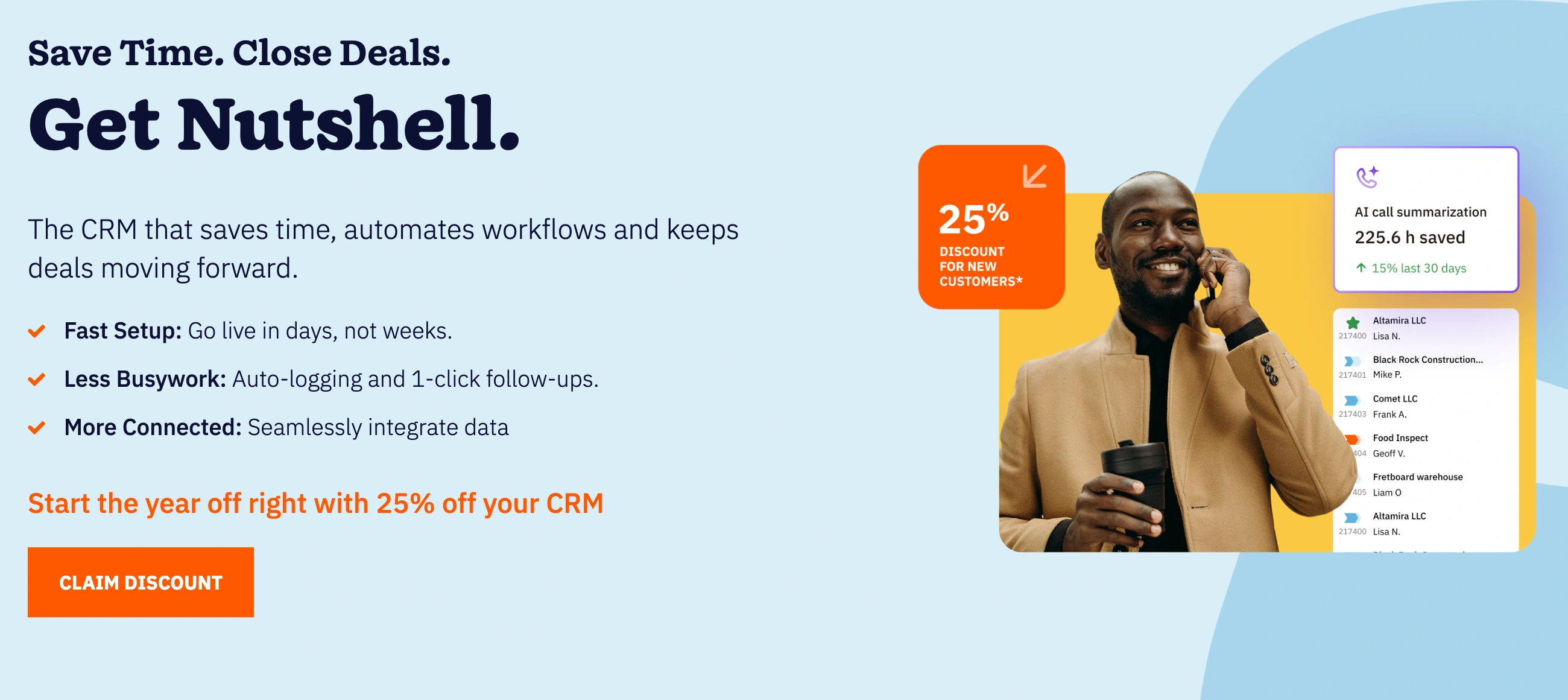
What it is: Simple B2B CRM designed for small sales teams who actually want to use their CRM daily—contact management, pipeline tracking, and email automation without the Salesforce complexity.
Best for: Small-to-midsize B2B sales teams (5-50 people) tired of fighting with complex CRMs. You're switching from Salesforce because nobody uses it, or from HubSpot because it priced you out, or from spreadsheets because you've finally outgrown them.
Main limitation: Reporting stays basic and customization hits walls faster than you'd expect. Advanced automation feels limited, web forms need work, and fast-growing companies outgrow it around 50-75 users when they need sophisticated workflows the platform can't deliver.
Get it if: Your current CRM has 30% team adoption and you need something people will actually use. You value speed to productivity over endless customization. You want US-based support that responds in hours, not days.
Skip it if: You need enterprise-grade reporting dashboards with 15 custom views, complex multi-system automation workflows, or you're planning to scale past 75 users within 18 months. Consider Salesforce or HubSpot Enterprise despite the higher costs and complexity.
🎯 Why Nutshell?
Your sales team is drowning in CRM complexity. Salesforce requires a full-time admin. HubSpot's pricing doubled when you added users. Your current platform has 30% adoption because reps find it too complicated. Nutshell flips this—teams get productive in hours, not weeks.
Teams Actually Use It (Unlike What You Have Now)
The stat that matters: 80-90% team adoption versus the 30-40% you're probably seeing now. "It's the only CRM my team has actually wanted to use," one reviewer states. Why? Sales reps log contacts and move deals without fighting the interface. No IT degree required. This means cleaner data, better forecasting, fewer deals falling through cracks.
Half the Cost, Same Core Features
HubSpot Professional runs $50-80 per user monthly. Nutshell Pro delivers comparable features at $42-49 per user. For a 10-person team, that's $420-490 monthly versus $500-800—savings of $80-310 monthly or $960-3,720 annually. The gap widens at 20+ users. Plus unlimited contacts on all plans while HubSpot caps and charges more.
Setup Takes Days, Not Months
Salesforce implementations eat 3-6 months and $10K-50K in consultant fees. HubSpot takes 4-8 weeks of dedicated onboarding. Nutshell? Teams go live in 2-7 days including data migration and training. Free white-glove migration assistance handles the heavy lifting. No consultants, no IT projects, no waiting.
US-Based Support That Helps
Free live support on all tiers from real humans based in the US. Not outsourced ticket systems that take three days to respond with unhelpful scripts. "The Nutshell team is very responsive and helpful," reviewers consistently report. Response times run 2-4 hours during business hours. This alone justifies switching for teams burned by slow support elsewhere.
But Here's the Honest Trade-Off
Reporting hits walls around month 6-12. "Reporting could be more powerful and flexible, especially as you start to want deeper insights," verified users note. Custom dashboards feel limited. Advanced analytics require CSV exports to Excel. If your VP of Sales needs 15 different pipeline views, you'll hit friction fast. The simplicity that makes it easy also limits what it can do—this is a feature, not a bug.

📈 What Nutshell Users Typically Achieve
CRM Adoption Finally Works
Teams switching from Salesforce or complex CRMs see adoption jump from 30-40% to 80-90%. Why? Reps stop fighting the interface. Adding contacts takes seconds. Pipeline updates happen during calls instead of being delayed because "I need to figure out the CRM first." Clean data follows naturally, forecasting accuracy improves, deals stop falling through cracks.
Implementation Speed Transforms Planning
Salesforce takes 3-6 months plus consultant fees. HubSpot takes 4-8 weeks. Nutshell? Small teams (5-15 people) go live in 2-3 days. Mid-sized teams (20-50) complete rollout in 5-7 days. No consultants, no IT projects, no waiting. You make the decision Friday, team is using it by Wednesday.
Budget Relief Compounds
A 10-person team saves $900-4,700 yearly versus HubSpot while getting similar core features. At 20 users, savings hit $3,600-10,800 annually. Plus eliminated Mailchimp subscriptions save another $240-4,200 yearly. The money adds up when you're no longer paying per-user premiums for features you don't need.
Email Marketing Without the Headaches
Running campaigns directly in CRM eliminates manual list syncing with external tools. Audience segmentation uses deal stages and custom fields automatically. Opens and clicks tie directly to pipeline opportunities. "I've gotten several big orders from my email campaigns, proving its value for money," verified user confirms.
Where You Hit Ceilings
Month 6-12: Sales operations wants custom dashboards with 15 views—Nutshell can't deliver. Month 12-18: Marketing needs complex multi-touch attribution—basic reports fall short. Month 18-24: Growing teams need advanced automation connecting 5-7 systems—API limitations surface. Month 24-36: Fast-growing companies (15 to 75 employees) start evaluating migrations to Salesforce or HubSpot Enterprise.
The Migration Reality
Companies typically migrate because they succeeded—Nutshell helped them grow to where they need enterprise tools. Migration indicators: requesting features Nutshell won't build, exporting data weekly for analysis elsewhere, building workarounds for automation limits, hiring revenue operations person who finds platform restrictive. Migration costs $10K-30K in consultant fees, 2-3 months timeline, productivity dip during transition.
💡 Here's what works: Use Nutshell for years 1-3 of sales team growth (5 to 30 people). The simplicity accelerates adoption and keeps costs low while figuring out repeatable sales processes. Budget eventual migration to Salesforce once you hit 30-50 people or need dedicated revenue operations. Nutshell is training wheels that actually work—don't be ashamed to use them, just plan when to remove them.
🛠️ How Nutshell Works
Think spreadsheet-simple, not enterprise-complicated. The workflow feels familiar if you've used any business software before.
Setup
Sign up for 14-day free trial without credit card. Import contacts via CSV or direct connector from Salesforce, HubSpot, Pipedrive, or 50+ other CRMs. Nutshell's team handles migration free—you export, they import and map fields. Configure sales pipeline by adding stages (Prospecting, Qualified, Proposal, Closed). Connect Gmail or Outlook in 5 minutes for automatic email sync. Total setup time: 2-4 hours including data import.
Team Onboarding
Schedule 30-minute walkthrough with Nutshell team, included free. Sales reps learn to add contacts manually or via browser extension, log calls and emails with auto-sync, drag deals through pipeline stages, set follow-up reminders. "Sales staff were able to hit the ground running very quickly," reviewers confirm. Most reps manage pipeline by end of first day without multi-week training.
Daily Workflow
Add leads from web forms, email, LinkedIn, or bulk import. View pipeline in board, list, chart, or map layouts depending on preference. Send emails directly from CRM with open/click tracking. Templates save common messages. Email sequences automate follow-ups. Log calls, meetings, notes—automatically if using Gmail/Outlook sync. Tag teammates in deal notes. Round-robin lead assignment on higher tiers distributes incoming leads automatically.
Email Marketing
Create broadcasts or drip campaigns using drag-and-drop builder. Build web forms that auto-add contacts to CRM. Design landing pages without separate tools. Segment audiences using CRM data like deal stage or industry. Track opens, clicks, conversions tied to pipeline. This eliminates Mailchimp subscriptions and manual list syncing headaches.
Reporting
Standard reports show sales funnel conversion rates, activity by rep, pipeline forecast, quota attainment. Export to CSV for custom Excel analysis when built-in reports don't cut it. Higher tiers add audit logs and API access. The reports work for basic pipeline management but fall short when you need sophisticated analytics.
Mobile Access
iOS and Android apps let reps add contacts on the go, log calls from meetings, check pipeline remotely, get task reminders. "The mobile app is fantastic, allowing us to stay connected and updated even when we're on the go," users report. Note: mobile UI is less polished than desktop—some features require switching to laptop.
⚙️ Core Features & Performance
Contact & Pipeline Management That Works
Unlimited contacts on all tiers means no surprise bills when your database grows. Single pipeline on entry plans, five pipelines on mid-tier, unlimited on enterprise. Drag-and-drop interface feels natural. Custom fields let you track what matters—industry, deal size, lead source. Activity timelines show every interaction with each contact automatically. The core CRM functions work smoothly without fighting you.
Email Integration & Tracking
Gmail and Outlook sync logs emails automatically to contact records. Send from CRM with open/click tracking built in. Email sequences automate drip campaigns—set it once, runs forever. Templates save your common messages. The integration just works, which sounds basic but eliminates the manual logging that kills adoption elsewhere.
Sales Automation
Auto-assign leads to reps via round-robin or territory rules. Trigger emails when deals hit specific stages. Update deal stages based on activities. Set automatic follow-up tasks. The automation handles basics well but lacks the sophisticated multi-step workflows power users expect. Think "good enough for 80% of use cases" not "infinitely customizable."
Built-In Marketing Tools
Email broadcasts and drip campaigns run directly in CRM at $5/company monthly base (150 free emails included). Web forms capture leads from your website. Landing page builder creates simple pages without developers. A/B testing on higher tiers. SMS broadcasts available. This replaces Mailchimp/Constant Contact for most teams, saving $20-350 monthly in separate subscriptions.
Reporting & Analytics
Pre-built reports cover sales funnel, activity metrics, pipeline forecast, team performance. The reports are clean and useful for day-to-day management. But here's where it falls short: limited customization, restrictive filters, no complex multi-dimensional analysis. Power users end up exporting to Excel weekly. "Reporting could be more powerful and flexible," verified users consistently note.
Team Collaboration
Tag colleagues in notes. Share pipeline visibility across team. Role-based permissions control access. Activity feeds show team progress. Video call integration with Zoom. The collaboration features handle small-to-midsize teams well but lack the granular controls enterprises need.
Integration Ecosystem
50+ native integrations including QuickBooks, Slack, Mailchimp, Zapier. API access starting on mid-tier plans enables custom workflows. The integrations cover common needs but feel limited compared to Salesforce's thousands of apps. Works fine for standard business tools, frustrating if you need niche software connections.
⚠️ What's Missing: Advanced workflow automation, sophisticated reporting dashboards, deep customization beyond standard B2B sales, extensive API capabilities, unlimited storage (though caps are generous), enterprise-grade territory management.
📊 The Verdict: Our Assessment
Overall Rating: 8.4/10 - Nutshell nails simplicity and team adoption for small-to-midsize B2B sales teams. Choose it when ease of use matters more than enterprise features. Skip it when you need advanced customization or plan rapid scaling past 50 users.
⚠️ Trade-offs: The simplicity that enables 80-90% team adoption also limits advanced capabilities. You get core CRM excellence at half the cost but sacrifice reporting depth and workflow sophistication. Fast-growing companies outgrow it around 50-75 users.
⚠️ Skip if: You need enterprise reporting dashboards, complex automation across multiple systems, sophisticated territory management, or plan to scale beyond 75 sales reps within 18 months where limitations will frustrate.
💬 What Users Say: Reviews & Verified Experiences
User ratings: 4.3/5 on G2 (900+ reviews), 4.3/5 on Capterra (430+ reviews).
👍 Pros: What Users Love
- Actually Gets Adopted: "I've worked in different CRMs and Nutshell is definitely the easiest to use," Capterra reviewer states. "What I like best about Nutshell is how clean and intuitive the interface is—it's easy to onboard new team members without a huge learning curve."
- Implementation Speed: "The implementation went very smoothly, support from Nutshell staff was great, and I was up and running with Nutshell in days," G2 user reports. "From the get-go Nutshell was easy to set-up and easy to use, even by reluctant engineers new to the concept(s) of CRM."
- Support Quality: "The Nutshell team is very responsive and helpful when there is an issue or if I am trying to understand how to better use a feature," Gartner reviewer confirms. "Really impressed with their Support also that is a surprise every time I have a question they are there to help."
- Cost Savings: "I chose Nutshell after exploring more than a dozen CRM platforms when HubSpot priced me out of their market," Software Advice user states. "The Nutshell fees are about 20-25% of what we were paying on SalesForce."
- No Hidden Fees: "We can use the features without constantly feeling nickel-and-dimed," G2 reviewer notes. "Nutshell includes many features at no additional charge, saving us money because we do not need to purchase them from other companies. Customer Support is USA-based and usually prompt."
👎 Cons: Common Complaints
- Reporting Limitations: "Reporting could be more powerful and flexible, especially as you start to want deeper insights," G2 user reports. "Reporting and automation are more limited than some larger CRMs, and teams with very complex workflows may find themselves wanting deeper customization."
- Customization Walls: "Customization options are somewhat restricted—adding more custom fields or adjusting layouts would be a welcome upgrade," Capterra reviewer states. "While it is easy to use, the simplicity can sometimes feel limiting, with fewer advanced features."
- Web Forms Need Work: "We found limitations with the built in web forms and tracking, which meant we eventually had to move lead capture to a third party tool," verified G2 user notes.
- Email Issues: "The email integration and the difficulty in navigating responses. The lack of design capability in the email marketing blasts," Gartner reviewer complains. "Marketing Emails and the bounces drive my team crazy."
- Mobile App: "Mobile applications lack a user-friendly UI," SelectHub analysis confirms. Desktop features aren't always available or well-designed on mobile.
🚫 3 Critical Mistakes to Avoid
Mistake #1: Starting Too Small, Then Hitting Limits Fast
You grab the cheapest tier because budget is tight. Foundation plan at $13-19 per user seems perfect. Two months later you hit the 100 open leads cap with 150 active opportunities in pipeline. You're forced to constantly archive deals or upgrade mid-quarter when you didn't budget for it. Or you're stuck with one pipeline when your team actually sells via three different processes.
⚠️ Fix it: Foundation only works for 2-5 person teams managing under 100 total deals. Most growing teams need the mid-tier minimum—five pipelines handles new business plus renewals plus partnerships, automation saves 5-10 hours weekly per rep, unlimited leads removes artificial caps. Calculate honestly: (Number of reps × hours saved monthly × hourly rate) minus plan cost = ROI. If savings exceed $200 monthly, upgrade justified from day one.
Mistake #2: Expecting Enterprise Features at SMB Pricing
You're paying $42-49 per user and expecting Salesforce-level capabilities. You want 20 custom pipeline views, complex multi-system automation, sophisticated forecasting models. Then you slam into walls: "Reporting could be more powerful," "customization options are somewhat restricted," "advanced automation is limited." Frustration builds because you thought you were getting enterprise CRM at half price.
⚠️ Fix it: Understand what you're buying upfront. Nutshell trades depth for simplicity. You get 80% of enterprise functionality at 50-70% less cost and 90% less complexity. The limitations: basic reporting works for pipeline management not complex analysis (export to Excel for that), five pipelines cover most use cases not 15 different sales motions, customization handles standard B2B sales not highly specific workflows. Need the missing 20%? Budget for Salesforce at $100-150 per user or HubSpot Enterprise at $120-200 per user instead. Don't expect boutique restaurant experience at fast-food prices.
Mistake #3: Skipping Email Integration Setup
You implement Nutshell but don't properly configure Gmail or Outlook sync. Sales reps send emails from regular inbox instead of through CRM. Result: 60-70% of customer communications aren't tracked, managers have zero visibility into outreach activity, email sequences can't track opens or clicks, deal timelines show incomplete history. Data gaps destroy forecasting accuracy and make it impossible to identify what email approaches actually work.
⚠️ Fix it: Email integration is non-negotiable. Invest 30 minutes per rep during onboarding. Install browser extension for one-click contact adds from LinkedIn. Configure Gmail or Outlook sync following Nutshell's guide (takes 5 minutes). Set up email templates for proposals, follow-ups, check-ins. Train reps to send through Nutshell interface or BCC tracking address. Enable automatic activity logging so every email/call appears in timeline without manual entry. First month: audit each rep's usage—if they're not logging 80%+ of customer emails, retrain immediately. Proper tracking separates successful implementations (clean data, accurate forecasts) from failures (garbage data nobody trusts).
FAQ
How does Nutshell pricing compare to HubSpot for a 10-person team?
HubSpot Professional runs $50-80 per user monthly, totaling $6,000-9,600 annually for 10 people. Nutshell Pro delivers comparable features at $42-49 per user monthly, totaling $5,040-5,880 annually. You save $960-4,560 yearly with Nutshell while getting unlimited contacts, sales automation, email sequences, and pipeline management. The gap widens at 20+ users. HubSpot justifies premium pricing with deeper reporting customization (unlimited custom dashboards), advanced marketing automation, and better scaling past 100 users. Choose Nutshell when budget matters and core CRM features suffice. Choose HubSpot when you need sophisticated workflows and have budget flexibility. Both include email integration and team collaboration. Nutshell offers better value for straightforward B2B sales under 50 users.
Is Nutshell actually easier to use than Salesforce or other enterprise CRMs?
Yes, measurably easier. Setup time: Nutshell 2-7 days including migration versus Salesforce 3-6 months with consultants. Team onboarding: 30 minutes to productive versus 2-3 weeks training for Salesforce. User adoption: 80-90% daily usage in Nutshell versus 30-40% typical with complex enterprise CRMs. The interface resembles spreadsheet software more than video editing tools—if you use Excel, you can use Nutshell. Sales reps log contacts and move deals without IT support. The simplicity that makes it easy also limits customization—you get standard B2B workflows that work immediately but cannot build highly custom processes. Choose Nutshell when team adoption and speed matter more than endless configuration. Choose Salesforce when you need complex customization and have dedicated CRM administrators.
What limitations will I actually hit with Nutshell and when?
Month 1-6: Limitations barely noticed, core CRM works smoothly. Month 6-12: Reporting gaps surface when sales ops wants custom dashboards with 15 views—basic reports work for pipeline management but fall short for sophisticated analysis, you start exporting to Excel weekly. Month 12-24: Customization walls frustrate growing teams—five pipelines cover most needs but complex organizations with 10+ sales motions feel restricted, custom field limits become annoying, advanced automation requires Zapier workarounds. Month 24-36: Fast-growing companies (15 to 75 employees, 3x revenue growth) start migration planning to Salesforce or HubSpot Enterprise. Specific limitations: web forms lack sophistication (teams move to Typeform), mobile app less polished than desktop, email marketing design restrictive versus dedicated tools, API capabilities limited compared to enterprise platforms. Nutshell works excellently for years 1-3 of sales team growth (5 to 30 people) before limitations outweigh benefits.
Can I migrate from Salesforce or another CRM without losing data?
Yes, easier than most CRMs. Nutshell offers free white-glove migration assistance where their team handles imports—you do not do it yourself. Process: export data from current CRM (Salesforce, HubSpot, Pipedrive, Zoho, or 50+ others) to CSV or use direct connector. Nutshell migration team maps fields from old structure to new. They handle importing contacts, deals, activities, custom fields, notes. Timeline: 2-5 days for most migrations including cleanup. Support via email and scheduled calls throughout. Cost: free on all tiers as onboarding benefit. Caveat: complex custom objects or unusual data structures may require manual mapping—budget extra week for heavily customized CRMs with 500+ custom fields. User feedback consistently praises migration teams as helpful and responsive. Most common decision: which custom fields to keep versus retire (good opportunity to simplify). After migration: 30-minute team training gets reps productive immediately versus weeks learning complex platforms.
When should I upgrade from spreadsheets to Nutshell?
Upgrade when you hit these inflection points: (1) Sales team grows to 3+ people—spreadsheets cannot handle multiple reps sharing data, version control becomes nightmare, no collaboration features. (2) Pipeline exceeds 30-40 active deals—Excel becomes unwieldy, deals fall through cracks, forecasting accuracy suffers. (3) Email tracking matters—need to know who opened proposals, which follow-ups work, when to call versus email (spreadsheets offer none of this). (4) Manager needs visibility without asking for updates daily. (5) Professionalism matters—CRM proposals look more credible than email attachments. ROI calculation: average rep manages 50-80 deals quarterly, saves 30-60 minutes daily with CRM versus spreadsheets (finding info, logging activities, updating statuses) equals 2.5-5 hours weekly per rep. At $50 hourly rate that equals $125-250 weekly value or $6,500-13,000 annually per rep. Nutshell costs $156-588 annually per user depending on tier. Math works clearly. Stay with spreadsheets only when: solo founder managing under 20 total deals, sales cycle under 7 days (transactional not relationship-based), zero budget for software.
What happens to my data if I need to leave Nutshell later?
You own your data completely and can export everything anytime. Export options: CSV files for contacts, deals, activities, custom fields (works on all tiers). API access on mid-tier and above enables custom extraction scripts. No data held hostage, no export fees, no artificial barriers. The export includes all contact information, deal history, email threads, notes, custom fields, activity logs—everything you put in comes out. Migration to other platforms: most major CRMs (Salesforce, HubSpot, Pipedrive) accept Nutshell CSV exports with field mapping. Migration consultants charge $2K-10K depending on data complexity and destination platform. Timeline: simple migrations 1-2 weeks, complex ones 4-8 weeks. Common migration reason: outgrowing Nutshell around 50-75 users when needing enterprise features, not data lock-in or pricing surprises. Users consistently report clean exports without missing data or corruption.
Suggestly
Find your best-fit B2B tool in 90 seconds
✓ Free personalized recommendations
✓ Based on YOUR business needs
✓ No signup required

Nutshell