✨ Is Salesforce Right for You?
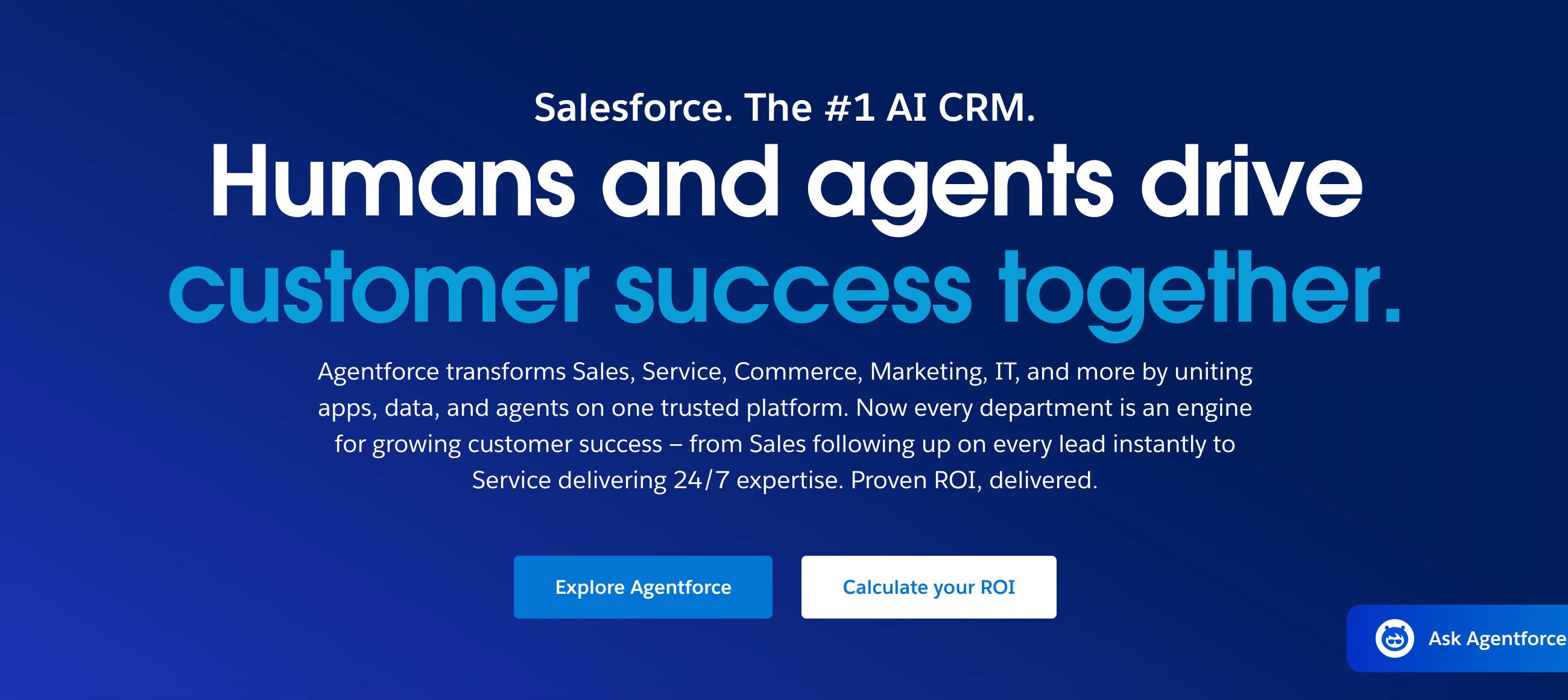
What it is: Enterprise CRM platform with deepest customization, Einstein AI, and massive AppExchange ecosystem. Multiple "Clouds" for sales, service, marketing. Implementation required.
Best for: Large enterprises (500+ employees) with complex sales processes, dedicated Salesforce admins, and budgets for $175+/user/month plus $25K+ implementation costs.
Main limitation: Prohibitively expensive for SMBs. Requires dedicated admins to manage. Implementation takes months. Learning curve steep. Hidden costs multiply fast.
Get it if: You're an enterprise needing maximum customization, have budget for full ecosystem investment, and can staff dedicated admins.
Skip it if: You're under 200 employees, need plug-and-play setup, lack admin resources, want predictable costs, or operate on SMB budgets.
🎯 Why Salesforce?
When enterprises say "we need a CRM," they usually mean "we need Salesforce." It's the 800-pound gorilla in CRM—most powerful, most customizable, most expensive, most complex.
💪 Unmatched Customization Depth
Salesforce doesn't just let you customize fields—you can rebuild the entire platform. Create custom objects, design unique workflows with Process Builder, code complex automations with Apex, and build completely bespoke interfaces with Lightning components. The AppExchange offers 7,000+ pre-built apps extending functionality infinitely. This flexibility attracts enterprises with unique requirements that off-the-shelf CRMs can't handle.
🧠 Einstein AI Throughout
Einstein predicts deal closures, scores leads automatically, suggests next-best actions, and provides conversation intelligence from sales calls. Unlike competitors adding AI as afterthoughts, Salesforce built Einstein natively into the platform architecture. This means AI insights flow through every module rather than existing as separate bolt-ons.
🏢 Enterprise-Grade Everything
Salesforce handles scale that breaks other CRMs. Millions of records, thousands of users, complex organizational hierarchies, multi-currency operations, global teams across dozens of timezones—Salesforce manages this without blinking. The platform offers robust security with field-level permissions, audit trails, and compliance certifications (SOC 2, HIPAA, GDPR) that enterprise legal teams demand.
🔗 Cloud Ecosystem Lock-In
Sales Cloud manages pipelines. Service Cloud handles support tickets. Marketing Cloud runs campaigns. Commerce Cloud powers e-commerce. Data Cloud unifies customer data. Each Cloud operates independently or together, creating comprehensive business management. But here's the catch: you pay separately for each Cloud, and they work best together, creating expensive ecosystem lock-in.

📈 What Salesforce Users Typically Achieve
Complete Sales Visibility Emerges
Every deal, every interaction, every customer touchpoint visible in one system. Sales managers finally see accurate pipeline forecasts instead of relying on rep guesses. "Salesforce Sales Cloud has improved visibility into our sales pipeline and helped streamline processes across departments," reports a Senior SDR.
Process Standardization Across Teams
Custom workflows enforce company methodology. Deal stages progress consistently. Required fields prevent incomplete data. Territory management auto-assigns leads to right reps. This standardization works brilliantly for enterprises with complex hierarchies needing uniform processes.
Data-Driven Decision Making
Dashboards surface trends invisible in spreadsheets. Einstein predictions highlight at-risk deals before they die. Conversation intelligence identifies top rep behaviors to replicate across team. The data depth enables strategic decisions that smaller CRMs can't support.
Ecosystem Consolidation (When It Works)
Teams using multiple Clouds eliminate tool sprawl. Sales Cloud + Service Cloud + Marketing Cloud creates unified customer view. But this only works if you can afford the full suite and have admins to integrate everything properly—which many can't.
🛠️ How Salesforce Works
Think of it as a development platform disguised as CRM. You don't just use Salesforce—you configure, customize, and continuously manage it.
Setup (Months, Not Hours)
Hire implementation partner or dedicate internal team. Map your existing sales process to Salesforce architecture. Configure user roles, permissions, and security settings. Design custom fields, objects, and page layouts for your needs. Build automated workflows using Process Builder or Flow. Migrate legacy data from spreadsheets or old CRM—expect data cleanup headaches. Train users on new interface and processes. Test everything in sandbox environment before going live. Implementation timeline: 3-6 months minimum, often 12+ for complex deployments. Cost: $25,000+ for basic implementations, easily $100,000+ for enterprise rollouts.
Daily Operations
Sales reps log into Salesforce homepage showing their pipeline, tasks, and Einstein suggestions. Create leads from web forms, import lists, or manual entry. Qualify leads through stages, convert to opportunities when ready. Track opportunities through customized sales stages on visual pipeline boards. Log activities—calls, emails, meetings—directly in records or via Gmail/Outlook integration. Collaborate using Chatter, Salesforce's internal social network for discussing deals with team members. Mobile apps provide full access on iOS/Android. Everything syncs across devices in real-time.
Admin Maintenance (Ongoing Forever)
Salesforce releases three major updates annually. Admins spend weeks testing changes, updating customizations, and training users on new features. Continuous configuration tweaking as business processes evolve. AppExchange app updates require compatibility testing. User permissions need constant adjustment as teams grow and roles change. Data quality maintenance to prevent duplicate records and ensure field accuracy. Report customization requests never stop. This isn't software you set up once—it requires dedicated admin resources indefinitely.
⚙️ Core Features & Performance
🎯 Sales Cloud Capabilities
Lead and opportunity management with customizable stages. Account and contact database with relationship mapping. Activity tracking for calls, emails, meetings, and tasks. Forecasting tools predict revenue with weighted pipeline analysis. Territory management assigns accounts to reps based on geography, industry, or custom rules. Quote and proposal generation with CPQ (Configure, Price, Quote) add-on. Einstein Opportunity Scoring ranks deals by closure probability. Conversation Intelligence analyzes sales call recordings for coaching insights.
🤖 Einstein AI Platform
Enterprise and Unlimited tiers unlock full Einstein. Predictive lead scoring identifies hottest prospects automatically. Deal insights surface risks and opportunities in pipeline. Activity capture auto-logs emails and calendar events. Email intelligence suggests optimal send times and subject lines. Conversation insights transcribe calls and highlight key moments. Forecasting accuracy improves using historical pattern analysis. But Einstein requires clean data to work effectively—garbage in, garbage out.
📊 Analytics & Reporting
Standard reports cover basic metrics out of box. Custom report builder creates complex multi-object analyses. Dashboards visualize data with charts, graphs, and tables. Einstein Analytics (formerly Tableau CRM) provides advanced BI for additional cost. However, many enterprises still buy separate Tableau licenses for serious analytics work, creating yet another expense layer.
🛠️ AppExchange Marketplace
7,000+ third-party apps extend Salesforce infinitely. Categories include marketing automation, document generation, e-signature, accounting integrations, project management, and industry-specific tools. Apps range from free to thousands monthly. Quality varies wildly—some are enterprise-grade, others are buggy add-ons that break during Salesforce updates. Vetting apps adds another layer of admin work.
🔐 Security & Compliance
Field-level security controls who sees what data. Role hierarchies determine record access. IP restrictions limit login locations. Two-factor authentication mandatory for many orgs. Audit trails track every data change. Compliance certifications: SOC 2 Type II, ISO 27001, HIPAA, GDPR, FedRAMP. This security depth justifies enterprise adoption but adds configuration complexity.
📱 Mobile Experience
Salesforce Mobile app provides full CRM access. Einstein Voice lets reps update records via voice commands while driving. Offline mode allows work without connectivity. However, mobile experience feels clunky compared to web interface—many reps still prefer desktop despite mobile availability.
🔗 Integration Ecosystem
Native integrations with Gmail, Outlook, Slack, Microsoft Teams. MuleSoft handles complex enterprise integrations but costs $15,000+ annually. API allows custom connections to any system. However, integration projects frequently balloon in cost as data mapping reveals complexity that simple connectors can't handle.
📊 The Verdict: Our Assessment
7.0/10 - Salesforce excels at enterprise-scale customization and power. Struggles with cost predictability, complexity, and SMB accessibility.
⚠️ Trade-offs: You buy enterprise power at enterprise costs. Implementation takes months. Requires dedicated admins forever. Hidden expenses multiply (add-ons, integrations, consultants, training). Pricing increased 6% in 2025. Overkill for most SMBs.
⚠️ Skip if: Under 200 employees, tight budgets, need quick deployment, lack admin resources, want predictable costs, or operate simple sales processes.
💬 What Users Say: Reviews & Verified Experiences
User ratings: 4.4/5 on G2, 4.4/5 on Capterra (ratings reflect satisfaction among those who can afford it).
👍 Pros: What Users Love
- Customization Depth: "The customizability of the software is excellent. If properly managed the product provides a great depth of features," notes a verified Capterra reviewer. "Our admin has built a tremendous amount of customization into Service Cloud."
- Enterprise Scale: "Salesforce Sales Cloud has been a reliable and robust CRM that has improved visibility into our sales pipeline and helped streamline processes across departments," shares a Senior SDR on Capterra.
- Detailed Tracking: "My favorite part about SalesForce was how detailed the tracking was. From the initial contact with a client to the final sale and every step in between, SalesForce allows you to log everything in detail," reports a Copywriter with 2+ years experience.
- Integration Power: "While other marketing automation systems offer Salesforce integrations, they're essentially iframed into Salesforce. Once diving into the details, there are inconvenient gaps that open up opportunities for human error," explains a VP of Marketing comparing to competitors.
👎 Cons: Common Complaints
- Cost Shock: "For small or budget-conscious businesses, the expense associated with Salesforce's subscription plans and additional add-ons may pose a significant financial challenges. As businesses scale and require more advanced features or additional user licenses, the cost of maintaining Salesforce CRM can escalate rapidly," warns a Salesforce Admin with 2+ years experience on Capterra.
- Revenue-First Mentality: "Instead of helping us optimize what we already pay for, Salesforce has constantly pushed us to buy more. Anytime we've tried to make changes to our contract to better align with our actual business needs, we're met with resistance," complains a verified G2 reviewer. "They've blindsided us with overage charges—on file storage, contact counts, and other usage metrics we were never clearly warned about."
- Admin Dependency: "The software is as good and as bad as the admins customize it. I have had experiences where the database is well managed with the right features and stages. I have had other experiences where the setup is messy and the inconsistencies are frustrating," notes a Capterra user.
- Learning Curve: "For many SalesForce has a bit of a learning curve. The software has a lot of settings, abilities and information so it's easy for someone new to get lost in it and feel confused," shares a verified reviewer.
- Implementation Complexity: "The cost is the main issue with this tool as well as getting it implemented and set up because of the vast number of features and customization available," warns a Business Owner on Capterra.
- Account Management Black Hole: "Their account management is beyond disappointing. There is no real support, no advocacy, and absolutely no empathy. It's a black hole of bureaucracy where no one seems empowered to do anything other than forward your issues to someone else—who also can't help," reports a frustrated G2 reviewer.
- Forced Ecosystem Purchases: "Our organization had required data points for us to fill daily, some of which were not as helpful for meaningful sales progress as others," notes an Executive Sales Manager about feature overload.
🚫 3 Critical Mistakes to Avoid
Mistake #1: Underestimating Total Cost of Ownership
Salesforce lists $25/user/month for Starter Suite, making it seem affordable. Reality hits different. Starter Suite ($25/user monthly, up to 10 users max) is deliberately limited—no Einstein AI, basic automation only, designed to upsell you fast. Most teams need Enterprise tier minimum: $175/user/month annually for Sales Cloud, Service Cloud, or Field Service. Want Marketing Cloud? Add $1,500/month per organization minimum. Need Einstein AI? Agentforce 1 tier costs $550/user/month. Implementation costs start at $25,000 for basic setups, easily exceeding $100,000 for complex deployments.
Hidden costs multiply: Dedicated Salesforce admin salary ($75K-$120K annually). Premium Success Plan for 24/7 support (30% of subscription cost). Data storage overages ($4/GB typically). MuleSoft for complex integrations ($15,000+ annually). AppExchange apps ($50-$500+ monthly per app). Ongoing consultant fees for updates and customizations. Training programs for continuous user education.
⚠️ Fix it: Calculate true annual cost: (Tier × Users × 12) + Implementation + Admin Salaries + Add-ons + Training + Consultants. A 50-person team on Enterprise ($175/user) pays $105,000 annually just for licenses. Add $50K implementation, $90K admin salary, $20K in add-ons, $15K training, $10K consulting = $290,000 first year, $190,000 annually ongoing. That's the real Salesforce cost.
Mistake #2: Buying Salesforce When You Need Something Simpler
Salesforce markets aggressively to SMBs with Starter Suite. But Salesforce is fundamentally built for enterprises. If you're under 100 employees with straightforward sales processes, you're paying for complexity you don't need. The customization depth that makes Salesforce powerful for enterprises becomes overwhelming bloat for small teams. You'll spend months configuring features you'll never use while paying enterprise prices.
⚠️ Fix it: Honestly assess your needs. Simple pipeline tracking? HubSpot free tier works. Growing team needing automation? Zoho Professional at $23/user gives you 90% of functionality for 87% less cost. Complex enterprise requirements with dedicated admin team? Then Salesforce makes sense. Don't buy Ferrari when you need Toyota—it doesn't make you faster, just broker.
Mistake #3: Launching Without Dedicated Admin Resources
Salesforce demands continuous administration. Three major updates annually require testing and user training. Business process changes need workflow reconfiguration. User permission requests pile up daily. AppExchange apps break and need fixes. Data quality degrades without active management. Teams buying Salesforce without dedicated admin capacity end up with expensive, poorly-configured systems that frustrate users and deliver minimal ROI.
⚠️ Fix it: Budget for full-time admin minimum. Larger deployments (100+ users) need admin teams. Admin responsibilities: system configuration, user training, workflow automation, data quality management, report creation, AppExchange app vetting, release testing, and ongoing optimization. Without this resource, your expensive Salesforce investment becomes shelfware. The admin salary ($75K-$120K) isn't optional—it's the price of entry for Salesforce success.
FAQ
Is Salesforce really that expensive?
Yes. Starter Suite ($25/user) is limited bait. Real usage requires Enterprise ($175/user/month) minimum. Add $25K+ implementation, admin salaries, add-ons, storage, integrations. Expect $200K+ annually for 50-person team all-in.
Can small businesses use Salesforce?
Technically yes via Starter Suite. Practically no—it's overkill. Built for enterprises with dedicated admins. SMBs (under 100 employees) better served by HubSpot, Zoho, or Pipedrive at fraction of cost.
Do I need a dedicated Salesforce admin?
Absolutely. Salesforce requires continuous configuration, three annual updates, user training, workflow management, and data quality maintenance. Without dedicated admin ($75K-$120K salary), investment fails.
How long does implementation take?
Minimum 3-6 months for basic setups. Complex enterprise deployments take 12+ months. Requires implementation partner ($25K-$100K+), data migration, workflow configuration, user training, and testing.
What's included in different tiers?
Starter ($25/user, 10 max): Basic CRM. Enterprise ($175/user): Automation, API, most features. Unlimited ($350/user): Full Einstein, 24/7 support. Agentforce 1 ($550/user): Maximum capabilities. Each Cloud (Sales, Service, Marketing) priced separately.
Salesforce vs HubSpot vs Zoho?
Salesforce: Most powerful, most expensive, needs admins, enterprise focus. HubSpot: Easy onboarding, expensive at scale, marketing-led. Zoho: Cheapest, good features, steep learning curve. Pick based on size, budget, and admin resources.
Suggestly
Find your best-fit B2B tool in 90 seconds
✓ Free personalized recommendations
✓ Based on YOUR business needs
✓ No signup required

Salesforce