✨ Is Zoho CRM Right for You?
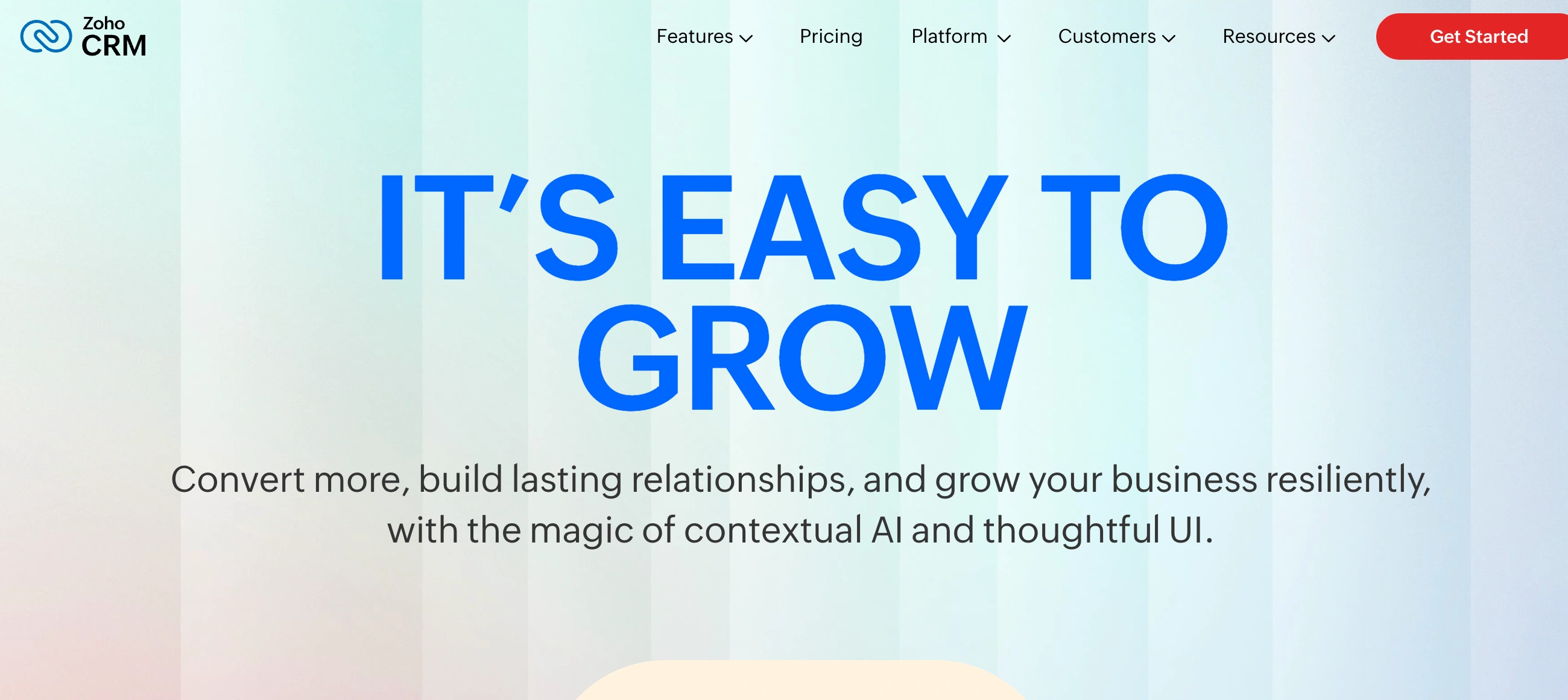
What it is: Affordable CRM with deep customization, AI assistant (Zia), and 40+ integrated Zoho apps. Free tier for 3 users, paid plans unlock automation and scale.
Best for: Budget-conscious businesses wanting Salesforce-level features without enterprise pricing. Works for startups through mid-market teams comfortable with technical setup.
Main limitation: Interface feels cluttered. Setup confuses new users. Customization requires technical knowledge. Inter-app integrations within Zoho ecosystem underwhelm despite promises.
Get it if: You prioritize affordability over ease of use and have someone technical to configure workflows properly.
Skip it if: You need plug-and-play simplicity, lack technical resources for setup, or want seamless onboarding without reading 15 YouTube tutorials.
🎯 Why Zoho CRM?
Salesforce costs thousands monthly. HubSpot locks essential features behind Professional tiers. Zoho delivers comparable functionality at a fraction of the cost—if you're willing to invest setup time upfront.
💰 Enterprise Features Without Enterprise Pricing
Blueprint process automation rivals Salesforce's process builder. Canvas lets you design completely custom CRM layouts for different teams. AI assistant Zia predicts deal closures and suggests next actions. Territory management, inventory tracking, and advanced analytics come standard on higher tiers. These capabilities typically require enterprise plans elsewhere—Zoho includes them on Professional and Enterprise tiers that cost less than most competitors' basic plans.
🔗 Ecosystem Play (For Better and Worse)
Zoho offers 40+ business apps: Mail, Books, Projects, Campaigns, Analytics, Desk. The vision is beautiful—one vendor, one login, unified data. The reality is messier. Native integrations between Zoho apps work better than third-party connections but still require Zoho Flow (their Zapier equivalent) for complex automations. You'll find yourself choosing between buying more Zoho apps or fighting integration headaches with best-of-breed tools.
🎨 Extreme Customization (If You Know How)
Most CRMs let you add custom fields. Zoho lets you rebuild the entire interface. Create custom modules with unique layouts. Design multi-step approval processes. Write client-side scripts triggered by user actions. Build Canvas screens that look nothing like default CRM. This flexibility attracts businesses with unique workflows—but also creates steep learning curves for teams expecting simple setup.

📈 What Zoho CRM Users Typically Achieve
Excel Chaos Eliminated
Scattered spreadsheets, sticky notes, and email folders consolidate into one searchable database. Teams instantly access any customer's complete history without digging through files. "Before using Zoho, I managed candidates in Excel, and it was complete chaos. Information was scattered everywhere," shares a G2 recruiter. "With Zoho, everything is centralized."
Automation Frees Repetitive Work
Follow-up reminders, task assignments, status updates, and email sequences run automatically once configured. "The platform takes care of repetitive tasks automatically, like sending follow-up reminders, updating statuses, and tracking emails. I no longer have to keep track of all these details myself," reports a G2 user. Time savings compound as teams scale.
Real-Time Team Visibility
Managers see who's working on what without status meetings. Deal stages update live across the team. "My team can now see who is working on what in real time, eliminating the need for weekly status meetings where I used to compile reports," notes a recruiter.
Significant Cost Savings
Teams report spending 60-75% less than Salesforce alternatives for comparable functionality. The free tier genuinely works for micro-businesses learning CRM basics. Standard and Professional tiers provide enterprise features at small business prices.
🛠️ How Zoho CRM Works
Think of it as modular building blocks you assemble based on needs. Start simple, add complexity as you learn the system.
Setup
Sign up for the free tier (3 users, basic features). Import contacts via CSV, Google Contacts, or direct email sync. Configure your sales pipeline stages—leads, contacts, deals, accounts organized into modules. Install mobile apps (iOS/Android) for field access. The platform provides setup wizards and templates, but expect confusion navigating endless tabs and settings. Most users report spending a week just understanding where everything lives before actual configuration begins.
Daily Operations
Log in to see your dashboard with pipeline overview, tasks, and Zia's AI suggestions. Click into Leads module to view prospects. Convert qualified leads to Contacts and create associated Deals. Track deal stages by dragging cards across pipeline boards. Log calls, emails, and meetings directly in contact records. Set task reminders and workflow automation rules. Use SalesSignals for real-time notifications when prospects engage. Everything updates across web, mobile, and email integrations simultaneously.
Scaling Up
As you outgrow free tier, upgrade to Standard for mass email and multiple pipelines. Professional unlocks Blueprint (guided sales processes), inventory management, and Google Ads integration. Enterprise adds advanced AI, comprehensive reporting, and custom functions. Ultimate provides maximum customization and support. Each tier removes specific limits while adding capabilities—storage, API calls, automation actions, and user permissions all expand progressively.
⚙️ Core Features & Performance
🤖 AI Assistant Zia
Zia analyzes your pipeline and predicts which deals will close based on historical patterns. She scores leads automatically, flags anomalies in data, suggests best times to contact prospects, and provides contextual email insights (summaries, intent analysis, sentiment detection). Enterprise and Ultimate tiers unlock advanced Zia capabilities like churn prediction, product recommendations, and comprehensive sales forecasting. Free and Standard tiers get basic Zia features only.
📋 Blueprint Process Automation
Available on Professional tier and above, Blueprint creates step-by-step guided workflows that sales reps follow. Define required fields at each stage, set approval processes, mandate specific actions before deals advance. This standardizes your sales process across the team—preventing shortcuts and ensuring compliance. Think of it as rails that guide reps through your methodology without allowing deviation.
🎨 Canvas Customization
Also Professional+, Canvas lets you build completely custom CRM screens tailored to specific roles or industries. Design layouts that show exactly what each team needs without clutter. Create action buttons that trigger custom functions. Build mobile-optimized views for field teams. This goes far beyond typical "custom fields"—you're redesigning the entire interface.
📊 Inventory & Order Management
Professional tier adds full inventory management: track products, vendors, price books, sales orders, purchase orders, and invoices directly in the CRM. This bridges the gap between CRM and ERP for businesses selling physical products. Integrate with Zoho Books for complete financial visibility without leaving the ecosystem.
📧 Email Marketing & Campaigns
Standard tier allows mass emails (250/day limit). Professional bumps this to 500/day with web-to-case forms and marketing integration. For serious email marketing, most teams add Zoho Campaigns separately or integrate third-party tools like Mailchimp. The built-in email tools work for basic outreach but lack sophistication of dedicated platforms.
📱 Mobile Apps & Offline Access
iOS and Android apps provide full CRM access on the go. Business card scanning captures contact details instantly. Offline mode lets field reps log activities without connectivity—data syncs automatically when online. The mobile experience matches desktop functionality, unlike many CRMs that offer watered-down mobile versions.
🔌 Integrations & API
Native connections with Google Workspace, Microsoft 365, Mailchimp, Slack, QuickBooks, and 500+ apps via marketplace. Zoho Flow handles inter-app automation within the ecosystem. However, users consistently report that integrations between Zoho's own apps (like Bookings-CRM or Inventory-CRM) require more manual configuration than expected. The API is robust for custom development but consumes daily credits that vary by tier.
📈 Reporting & Analytics
Standard includes basic reports and dashboards. Professional unlocks custom reports with advanced filters. Enterprise provides calculated fields, custom modules for analytics, and deeper insights. For comprehensive BI, many teams add Zoho Analytics separately. The reporting feels adequate but not exceptional—functional without being powerful.
📊 The Verdict: Our Assessment
7.5/10 - Zoho excels at value-for-money and deep customization. Struggles with interface complexity, setup difficulty, and integration promises versus reality.
⚠️ Trade-offs: You trade simplicity for savings. Interface overwhelms newcomers. Setup requires YouTube tutorials and patience. Aggressive sales calls post-demo (10/day starting at 7am reported). Inter-app integrations underwhelm despite ecosystem promises.
⚠️ Skip if: You need plug-and-play simplicity, lack technical resources, want intuitive onboarding, or prefer best-of-breed tools over all-Zoho ecosystem.
💬 What Users Say: Reviews & Verified Experiences
User ratings: 4.1/5 on G2, 4.3/5 on Capterra, 4.4/5 value-for-money rating.
👍 Pros: What Users Love
- Unbeatable Value: "Zoho CRM has the same functionality as other industry-leading CRMs, but at a fraction of the cost," shares a verified Capterra reviewer who implemented it at a 5-person startup.
- Ecosystem Integration: "I like the fact that ZOHO always adds new functionality. I also like that it is integrated with all its key software like Books, Campaigns, Projects," notes a 10-year user on Capterra.
- Customization Power: "For teams seeking control without enterprise bloat, Zoho CRM is incredibly flexible and affordable. The customization options (fields, workflows, automations) are extensive," reports a G2 reviewer.
- Mobile Functionality: "The mobile app provides full CRM access on the go with business card scanning and offline mode that syncs automatically," says a field sales user.
👎 Cons: Common Complaints
- Setup Nightmare: "The initial setup was confusing and took me almost a week to figure out. The interface has so many options that i kept getting lost trying to find basic features like how to create custom fields or set up automation rules," complains a G2 user. "Had to watch like 15 youtube videos just to understand the basics."
- Cluttered Interface: "The interface is overwhelming, cluttered with endless tabs and technical jargon that isn't clearly explained. It feels more like trying to navigate a complex enterprise system than a tool meant to help small businesses," warns a Capterra reviewer who requested a demo.
- Aggressive Sales Tactics: "After simply requesting a demo, I was relentlessly bombarded with calls—up to 10 times a day, starting as early as 7 a.m.," reports a small business owner on Capterra. "This level of aggressive sales outreach is intrusive and exhausting."
- Integration Gaps: "Apps are not as integrated as they could be. I spent a long time trying to customise their integrations between Zoho apps (that really should be there out of the box)," shares a consultant on Capterra. "Bookings and CRM, Bookings and Inventory cannot be integrated as needed without Zoho Flow."
- Technical Requirements: "If you have to go out of the way of the Zoho structure then the environment is tough to manipulate and requires things to go manual in many cases," notes a Marketing Manager on Capterra.
- Support Lottery: "Support is hit and miss. I have had responses within minutes and then other tickets I have had to chase for nearly a week to get a response," reports a long-time Zoho One user.
- Workflow Failures: "There are occasional times when the workflows fail to run properly, and this causes me MAJOR headaches," warns a Campaigns user about automation reliability issues.
🚫 3 Critical Mistakes to Avoid
Mistake #1: Underestimating Setup Complexity
The free tier looks simple until you try customizing workflows or integrating apps. The interface buries basic settings under endless tabs. Custom fields, automation rules, and Blueprint processes require technical knowledge most small business owners don't have. Users consistently report spending a full week just learning where everything lives before productive configuration begins.
⚠️ Fix it: Budget time for learning, not just software costs. Watch Zoho Academy tutorials before your trial starts. Consider hiring a Zoho consultant for initial setup ($75-$150/hour typically). Or accept the free tier's limitations and upgrade only when you have technical resources to configure properly. Don't assume plug-and-play—assume homework.
Mistake #2: Believing the Ecosystem Integration Promise
Zoho markets seamless integration across 40+ apps. Reality delivers fragmented experiences. Connecting Zoho Bookings to Zoho CRM? You'll need Zoho Flow. Syncing Campaigns with CRM? Prepare for manual configuration. "Apps are not as integrated as they could be. I spent a long time trying to customise their integrations between Zoho apps that really should be there out of the box," warns a consultant who's implemented Zoho for multiple clients.
⚠️ Fix it: Test specific integrations you need during your free trial. Don't buy multiple Zoho apps assuming they'll talk automatically. Budget for Zoho Flow subscriptions or third-party middleware like Zapier. Sometimes best-of-breed tools with native integrations beat all-Zoho ecosystems that require constant workarounds.
Mistake #3: Ignoring True Costs Beyond List Price
Free tier: 3 users, 10MB storage, one pipeline, no mass email, no automation. Works for solopreneurs testing CRM but hits limits fast. Standard: $14/user/month annually ($20 monthly) adds mass email (250/day), workflows, and custom fields. Most small teams need this minimum. Professional: $23/user/month annually ($30 monthly) unlocks Blueprint, Canvas, inventory management, and serious automation. This is where Zoho's power emerges—and where 10-person teams pay $230/month (annual) or $300/month (monthly). Enterprise: $40/user/month annually ($50 monthly) for advanced AI, territory management, and comprehensive reporting. Ultimate: $52/user/month annually for maximum features.
Hidden costs multiply: Extra storage ($4/GB/month), additional API credits for heavy integrations, Zoho Flow subscriptions for app connections, and consultant fees for complex configurations. A 10-person team on Professional paying annually ($2,760/year) plus storage and Flow can easily hit $3,500-$4,000 annually—still cheaper than Salesforce but not the "$14/user" sticker price suggests.
⚠️ Fix it: Calculate total cost including: tier × users × 12 months + storage overages + Flow subscriptions + setup consulting. Compare this against your current costs or alternatives. Zoho remains affordable but isn't free once you need real functionality. Budget realistically for Professional tier minimum if you want automation and customization that differentiate Zoho from basic CRMs.
FAQ
Is the free tier actually usable?
Yes for 3-person startups doing basic contact management. No for real sales operations. You get 10MB storage, one pipeline, no mass email, no automation. Most teams need Standard ($14/user annually) minimum.
How hard is Zoho to set up really?
Genuinely difficult. Users report spending a week finding basic settings before actual configuration. Interface cluttered with tabs and jargon. Expect 15+ YouTube tutorials to understand fundamentals. Not plug-and-play.
Do Zoho apps integrate seamlessly?
No, despite marketing claims. Inter-Zoho integrations require Zoho Flow for complex automations. Bookings-CRM, Inventory-CRM, and other combos need manual configuration. Third-party integrations sometimes work better than native Zoho connections.
What's the real monthly cost for 10 users?
Professional tier (needed for automation): $230/month annual billing ($300 monthly billing). Add storage overages, Flow subscriptions, potential consultant fees. Budget $250-$350/month realistically.
Zoho vs Salesforce vs HubSpot?
Zoho: Cheapest, deepest customization, steepest learning curve. Salesforce: Most powerful, most expensive, enterprise focus. HubSpot: Easiest onboarding, expensive at scale, marketing-led. Pick based on budget vs simplicity priority.
Can non-technical teams use Zoho successfully?
Possible but challenging. Free and Standard tiers manageable with effort. Professional+ customization (Blueprint, Canvas) requires technical knowledge or consultant help. If your team struggles with complex software, consider easier alternatives.
Suggestly
Find your best-fit B2B tool in 90 seconds
✓ Free personalized recommendations
✓ Based on YOUR business needs
✓ No signup required

Zoho CRM