
✨ Is Shopify Right for You?
What it is: The gold standard ecommerce platform built specifically for selling products online. Powers 800,000+ stores from side hustles to enterprise brands.
Best for: Anyone serious about ecommerce—whether launching your first product line, growing an established store, selling physical goods, dropshipping, or managing inventory across multiple channels.
Main limitation: Apps escalate costs fast beyond base pricing. Limited user accounts push you to expensive plans quickly. Less capable for content-heavy sites or blogs compared to WordPress. Transaction fees bite if you do not use Shopify Payments.
Get it if: Selling products is your primary business, you need robust inventory management, want multi-channel selling (social, marketplace, in-person), or plan to scale beyond hobby level sales.
Skip it if: Your site is primarily content with light product sales, you need extensive blogging features, have extremely tight margins sensitive to fees, or want a simple portfolio site with occasional merch.
🎯 Why Shopify?
Most website builders tack on ecommerce as an afterthought. Shopify does the opposite—it is built for selling, then lets you add content around it. That focus makes all the difference when products are your business.
💼 Ecommerce That Actually Works
Inventory tracking across unlimited products and locations. Automated tax calculations for every jurisdiction. Shipping label printing with deeply discounted carrier rates (up to 88% off retail). Abandoned cart recovery that actually converts. These are not add-ons—they are built in. Competitors charge extra or make you hack together third-party tools. Shopify handles it natively because selling is the core, not a feature.
🌍 Sell Everywhere From One Dashboard
Your online store, Instagram Shop, Facebook Marketplace, Amazon, eBay, TikTok Shop, and physical retail—all syncing inventory in real-time. Update stock once, it reflects everywhere. One dashboard shows sales across every channel. This omnichannel capability is why serious sellers choose Shopify. Managing five separate systems is chaos. One unified platform is sanity.
📦 Dropshipping & Print-on-Demand Ready
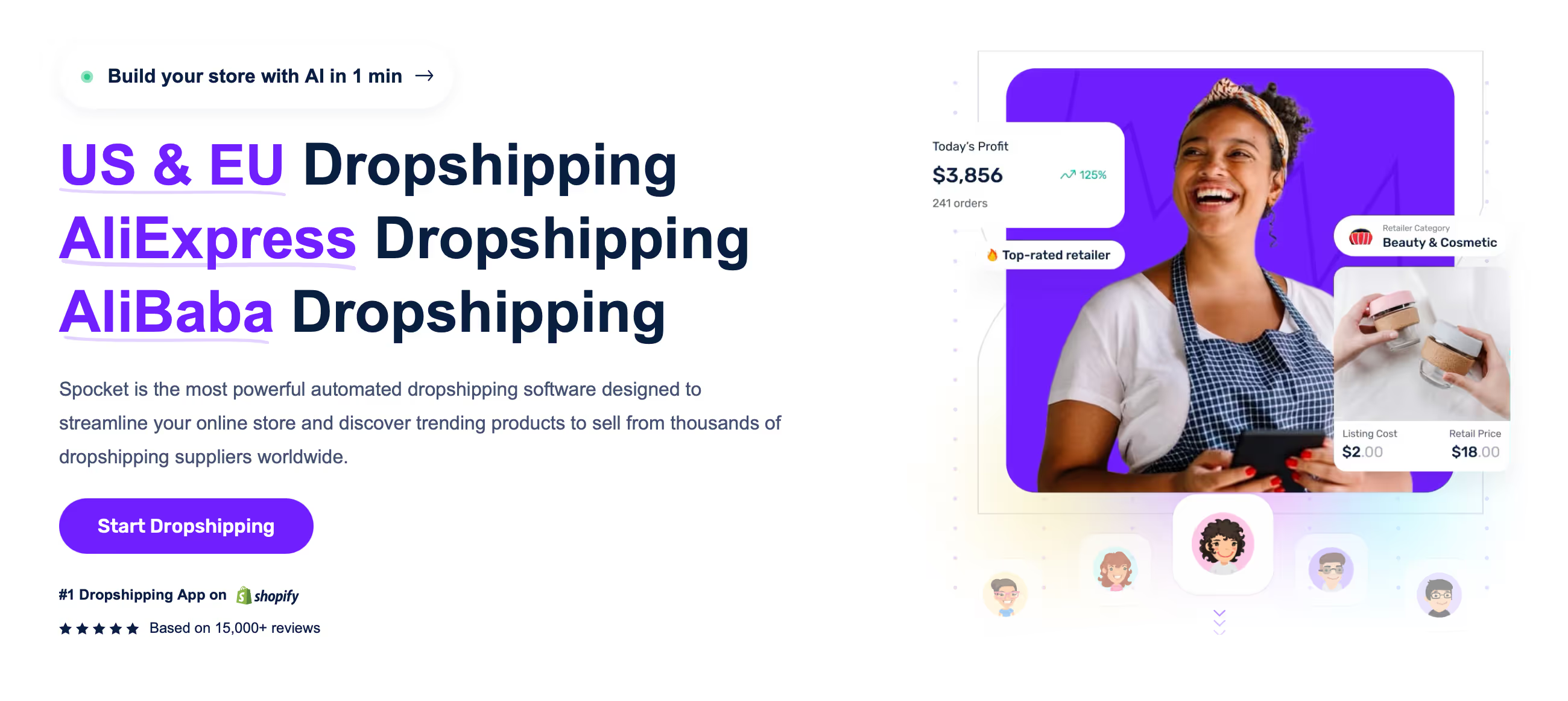
Connect to Printful, Printify, Spocket, Oberlo, or thousands of suppliers through apps. Orders route automatically. No touching inventory. The app ecosystem makes dropshipping and print-on-demand simple—find products, import them, start selling. This business model works because Shopify built specifically for it.
📊 Data That Drives Decisions
Sales reports, traffic analytics, conversion tracking, customer lifetime value, top products—everything you need to understand what is working. Advanced plan adds custom report building. The analytics help you stop guessing and start knowing which products, campaigns, and channels actually make money.

📈 What Shopify Users Typically Achieve
Launch and Scale Product Businesses
That product idea you have been sitting on? Launch it this month. Shopify handles the technical stuff—payments, security, hosting, checkout—so you focus on products and marketing. Stores go from zero to first sale in days, not months. Then scale from side hustle to six figures on the same platform without migrations or rebuilds.
Multi-Channel Revenue Without Chaos
Sell on your website, Instagram, Facebook, Amazon, and in-person simultaneously. Inventory syncs automatically across every channel. One dashboard shows all sales. This turns fragmented selling into a unified business. Update a product once, it updates everywhere. The time savings are massive compared to managing separate systems.
Professional Logistics Without Expertise
Print shipping labels with huge carrier discounts (up to 88% off). Automatically calculate taxes for every jurisdiction. Process returns and refunds through simple workflows. Handle it all without becoming a logistics expert. These operational efficiencies mean selling feels manageable even as order volume grows.
Where You Will Hit Friction
App costs compound fast—email marketing $30/month, reviews $15/month, subscriptions $20/month, upsells $25/month. That $29 Basic plan becomes $120/month once you add necessary apps. Limited user accounts (2 on Basic) force upgrades if you hire help. Transaction fees bite if you use third-party payment processors. Content marketing feels limited compared to WordPress.
💡 Here is what works: Start on Basic plan ($29/month annual), use Shopify Payments to avoid transaction fees, budget $50-100/month for essential apps from day one. Upgrade to Shopify (Grow at $105/month) only when sales exceed $30K/month—fee savings justify the cost. For content-heavy strategies, consider WordPress with WooCommerce instead. Use Shopify for what it does best: selling products at scale.
🛠️ How Shopify Works
Building a Shopify store feels purpose-built for commerce—every feature points toward making sales.
Initial Setup
Sign up for the $1/month intro period (first 3 months), pick a theme from 1,000+ options (24 free, rest $100-500), customize colors and fonts, add products with descriptions and images. The setup wizard guides you through domain connection, payment processing, shipping zones, and tax settings. Most stores go live within a few days. The interface makes sense because it is organized around the sales process, not generic website building.
Managing Products
Add products with variants (size, color, material), set inventory levels, organize into collections, assign tags for filtering. Product management handles simple single items or complex catalogs with thousands of SKUs. Import products via CSV for bulk uploads. Connect print-on-demand or dropshipping apps to auto-sync inventory. The system tracks stock levels, sends low inventory alerts, and prevents overselling.
Processing Orders
Orders appear in your dashboard with customer info, products purchased, payment status. Print shipping labels directly from Shopify with discounted rates. Mark items as fulfilled, email tracking numbers automatically. Handle returns, refunds, and exchanges through the order management system. For physical retail, Shopify POS processes in-person sales and syncs with your online inventory.
Growing & Scaling
Install apps from the 13,000+ marketplace for email marketing, reviews, upsells, subscriptions, or any other feature. Connect Google Analytics, Facebook Pixel, and conversion tracking. Create discount codes, run sales, set up automatic promotions. The platform scales from first sale to enterprise—same dashboard, more sophisticated features as you grow.
⚙️ Core Features & Why They Matter
🛒 Complete Ecommerce Foundation
Unlimited products, variants (size/color/material), inventory tracking across 10+ locations, automated tax calculations for every jurisdiction, shipping rate calculations, abandoned cart recovery, discount codes, gift cards. Everything you need to run a real product business is included. Compare this to Wix or Squarespace where you pay extra or hit limits. Shopify does not nickel-and-dime the basics.
💳 Payment Processing That Works
Shopify Payments (powered by Stripe) is built in—2.9% + 30¢ on Basic plan, down to 2.5% + 30¢ on Advanced. Accept credit cards, Apple Pay, Google Pay, Shop Pay instantly. Use third-party processors if you prefer, but expect transaction fees (2% on Basic, 0.6% on Advanced) on top of processor fees. Over 100 payment gateways supported globally. International selling handles currency conversion and local payment methods.
📦 Shipping & Fulfillment
Print shipping labels with up to 88% off USPS, UPS, DHL rates directly from Shopify. Calculate shipping costs in real-time at checkout. Set up flat rate, free shipping thresholds, or carrier-calculated rates. Connect to fulfillment services like ShipStation or Amazon FBA. The logistics tools mean you are not manually managing spreadsheets and carrier websites—everything flows through one system.
📱 Multi-Channel Selling
Instagram Shopping, Facebook Shop, TikTok Shop, Pinterest Product Pins, Amazon, eBay—connect them all. Sell in-person with Shopify POS (free POS Lite included, POS Pro $89/month). Inventory syncs across every channel automatically. This omnichannel approach is Shopify's superpower. One product update everywhere versus managing five separate systems.
🤖 13,000+ App Ecosystem
Email marketing (Klaviyo, Mailchimp), reviews (Judge.me, Loox), subscriptions (Recharge), upsells, bundles, loyalty programs, SEO, accounting integrations—if you need it, an app exists. Free apps cover basics, premium apps $5-300/month add advanced features. This flexibility is massive but the cost adds up fast. Budget $50-200/month for apps realistically.
⚠️ What is Missing: Advanced blogging features (WordPress is better), content management sophistication, free migration tools from other platforms, generous user accounts on lower plans (Basic = 2 users), native multi-language (requires apps).
📊 The Verdict: Our Assessment
9.2/10 - Shopify dominates ecommerce platforms for good reason. Best-in-class selling features, proven scalability, massive app ecosystem. Weaker on content sites and app costs escalate, but unmatched for product-focused businesses.
⚠️ Trade-offs: Ecommerce excellence comes with app dependency and escalating costs. Limited user accounts force plan upgrades. Transaction fees if you do not use Shopify Payments. Content features trail WordPress.
⚠️ Skip if: Your site is primarily content with occasional product sales, you need sophisticated blogging, have razor-thin margins sensitive to every fee, or want simple portfolio with light merch.
💬 What Users Say: Reviews & Verified Experiences
User ratings: 4.4/5 on G2 (4,500+ reviews), 4.5/5 on Capterra (6,100+ reviews).
👍 Pros: What Users Love
- Ecommerce Just Works: "The out-of-the-box e-commerce solution is stellar, and it is relatively easy for people with a base understanding of CMS to thrive quickly. It integrates with so many other platforms," shares a Capterra partner in food and beverages. The selling features work without fighting the system.
- Multi-Channel Simplicity: "I love that Shopify can easily integrate into our companies POS system. As a 3PL, it is important that we can easily ingest orders and get them out the door as quickly as possible for our clients," notes a fulfillment manager on Capterra. One dashboard controlling everything saves massive time.
- Scales With Your Business: "Shopify has been very easy for me to stand up a web store on short notice. Documentation is widely available and has allowed me to unlock a TON of value from the package we signed up for," reports a G2 reviewer. Start simple, add complexity as you grow.
- Intuitive Product Management: "I use Shopify to manage orders and upload products to the website; I find these features very intuitive and fast, making my work easier. The ability to make real-time changes to an order or to an item on the site is extremely useful," explains a Capterra ecommerce assistant. The interface makes sense for selling.
👎 Cons: Common Complaints
- App Costs Escalate Fast: "Like any SAAS worth its value, some features you want are hidden behind paywalls, but it is flexible enough that there is almost always a way around it if you are creative, or it is inexpensive via 3rd party apps," warns a Capterra reviewer. The base price looks reasonable until you add necessary apps.
- Shopify Plus Underwhelms: "After 11 years of use, overall very disappointed with Shopify. And don't be fooled that if you just upgrade, the offering will be better: we tried plus (it was underwhelming to say the least, and a complete rip off on price," complains a verified Capterra founder. The enterprise tier is expensive without proportional value.
- Limited Without Apps: "The only downside I am noticing at the moment is that Shopify is not able to fully communicate with our shipping service, ShippyPro," reports a Capterra user. Native features are strong but specific needs require paid apps.
- Blogging Features Basic: Multiple G2 reviewers note content management lags WordPress. For content-heavy businesses, the blogging tools feel limiting compared to dedicated CMS platforms.
🚫 3 Critical Mistakes to Avoid
Mistake #1: Not Budgeting for App Costs Beyond Base Price
A jewelry store launched on Basic plan ($29/month), then needed email marketing (Klaviyo $30/month), reviews (Judge.me $15/month), size guide ($10/month), Instagram feed ($8/month), and inventory alerts ($12/month). Monthly cost jumped from $29 to $104. Over a year, that is $900 more than budgeted. The "affordable" platform became expensive once real business needs emerged.
⚡ Fix it: Research required apps before launching. Browse Shopify App Store for your industry and list essential tools. Budget $50-150/month for apps realistically from day one. Many businesses underestimate this and face sticker shock. Free apps exist but often lack features you actually need. Plan for premium app costs—they are not optional for serious stores. The true Shopify cost is base subscription plus apps plus payment processing fees.
Mistake #2: Choosing Wrong Plan for Transaction Fees
A print-on-demand store used PayPal instead of Shopify Payments to avoid switching. On Basic plan, that means 2% transaction fee plus PayPal 2.9% + 30¢. For $50K monthly sales, that is $1,000/month in unnecessary Shopify transaction fees ($12,000/year). Shopify Payments would eliminate that $1,000 entirely. The "savings" from staying with PayPal cost $12,000 annually.
⚡ Fix it: Use Shopify Payments whenever possible—it eliminates transaction fees entirely on all plans. Third-party processors trigger these extra fees that kill margins. If you cannot use Shopify Payments (international restrictions, need specific processor), calculate the transaction fee impact on your margins. For a $50K/month store on Basic plan with third-party processor, you are paying $12K/year in avoidable fees. Sometimes upgrading plans makes sense purely for lower transaction fees at high volume.
Mistake #3: Outgrowing Basic Plan But Not Upgrading
A supplement company stayed on Basic plan ($29/month) as they grew to $80K monthly sales. They needed more staff accounts but Basic allows only 2. Hired customer service and fulfillment help had to share logins, creating security risks and workflow bottlenecks. Lost an estimated 10-15 hours weekly to coordination inefficiencies. That is $3,000-5,000 annually in wasted time trying to save $76/month by avoiding Shopify (Grow) plan.
⚡ Fix it: Upgrade when the math makes sense. At $30K+/month in sales, lower transaction fees on Shopify plan offset the higher subscription cost. The 5 staff accounts eliminate sharing logins. Advanced reports help optimize what is working. Calculate: does paying $76/month more save more than that in fees and efficiency? Usually yes at scale. Penny-wise, pound-foolish thinking keeps successful stores on inadequate plans. Your business growth should drive platform growth, not artificial cost constraints.
FAQ
Which Shopify plan should I actually choose?
Basic plan ($29/month annual) works best for most new stores—includes full ecommerce features, unlimited products, 2 staff accounts. Use Shopify Payments to avoid 2% transaction fees that would cost you dearly. Shopify (Grow at $105/month) makes sense once you exceed $30K monthly sales—lower transaction fees (1% vs 2%) and more staff accounts (5 vs 2) justify the upgrade. Advanced plan ($399/month) only works at $150K+ monthly or when you need 15 staff accounts. Start Basic, upgrade when transaction fee savings exceed the plan cost difference. Most stores should avoid Starter ($5/month)—it is checkout links only, no real storefront. The $1/month intro offer (first 3 months) applies to any plan, so test features before committing long-term.
How much do apps really add to monthly costs?
Realistically budget $50-200/month for apps beyond base subscription. Essential apps for most stores: email marketing $20-40/month (Klaviyo, Omnisend), product reviews $10-20/month (Judge.me, Loox), upsells/bundles $15-30/month, customer service chat $10-20/month, subscription billing $20-40/month if needed. Many businesses underestimate this and get shocked when that $29 Basic plan becomes $120/month total. Free apps exist but typically lack features serious stores need. Advanced stores spending $200-500/month on apps is common. Before choosing Shopify, browse the App Store for your industry and price out required tools. The app ecosystem is powerful but costs compound quickly. Factor this into your budget from day one.
Should I use Shopify Payments or a third-party processor?
Use Shopify Payments whenever possible—it eliminates transaction fees entirely. With third-party processors (PayPal, Stripe, others), Shopify charges 2% on Basic, 1% on Shopify, 0.6% on Advanced on top of processor fees. For a $30K/month store, that is $600/month ($7,200/year) in avoidable fees on Basic plan. Shopify Payments rates are competitive: 2.9% + 30¢ on Basic, down to 2.5% + 30¢ on Advanced. The only reasons to use third-party processors: international restrictions preventing Shopify Payments access, need for specific local payment methods, contractual obligations to existing processor. If you can use Shopify Payments, do it—the transaction fee savings pay for themselves immediately. Run the math on your expected volume to see the difference.
Can I migrate from another platform to Shopify easily?
Product data and customer info migrate reasonably well through CSV imports or migration apps like LitExtension ($69-299 one-time). Store design and customizations require rebuilding—your Wix or Squarespace design will not transfer. Budget for theme setup and customization ($0 with free themes, $100-500 for premium, $2,000-10,000 for custom design). Order history can migrate but requires setup. Apps and integrations need reconnecting. Most migrations take 2-6 weeks depending on catalog size and complexity. Professional migration services cost $500-3,000 for standard stores. The technical migration is doable, but expect investment in redesign and setup time. For stores doing $10K+ monthly, the migration cost pays back quickly through Shopify's superior features.
How does Shopify compare to WooCommerce and BigCommerce?
Shopify wins on ease of use and built-in features—everything works out of the box. WooCommerce wins on flexibility and control—it is open source WordPress, unlimited customization but technical complexity. BigCommerce competes directly with Shopify at similar pricing but less app ecosystem. Cost comparison: Shopify Basic $29/month all-in, WooCommerce $10-50/month hosting plus maintenance complexity, BigCommerce Standard $29/month. Choose Shopify for: turnkey solution, not wanting to manage hosting/security, needing multi-channel selling, valuing support. Choose WooCommerce for: maximum control, content-heavy sites, existing WordPress site, technical capability to manage it. Choose BigCommerce for: built-in features without apps, B2B needs, wanting Shopify alternative. Most small-medium businesses choose Shopify for reliability and support despite higher total cost with apps.
Is Shopify Plus worth $2,000+/month for enterprise?
Shopify Plus starts at $2,000/month (up to $2,500 for short contracts) plus 0.25% on sales over $800K monthly, capped at $40,000/month platform fee. Worth it when: annual revenue exceeds $5M, need 10+ expansion stores for multi-brand or international, B2B wholesale requires advanced features, custom checkout critical, dedicated account management valuable. Not worth it when: revenue under $2M annually, single-brand operation, standard features sufficient, trying to justify it just for 'unlimited' staff accounts. Many mid-market stores ($1-5M annual) stay on Advanced plan ($399/month) and save $20K+ annually versus Plus. Shopify Plus makes sense at scale but is often oversold to businesses not ready. Run the math: does $24K/year minimum justify the features versus Advanced plan? For genuine enterprise operations, yes. For ambitious startups, usually no until revenue supports it.
Suggestly
Find your best-fit B2B tool in 90 seconds
✓ Free personalized recommendations
✓ Based on YOUR business needs
✓ No signup required

Shopify