✨ Is Notion Right for You?
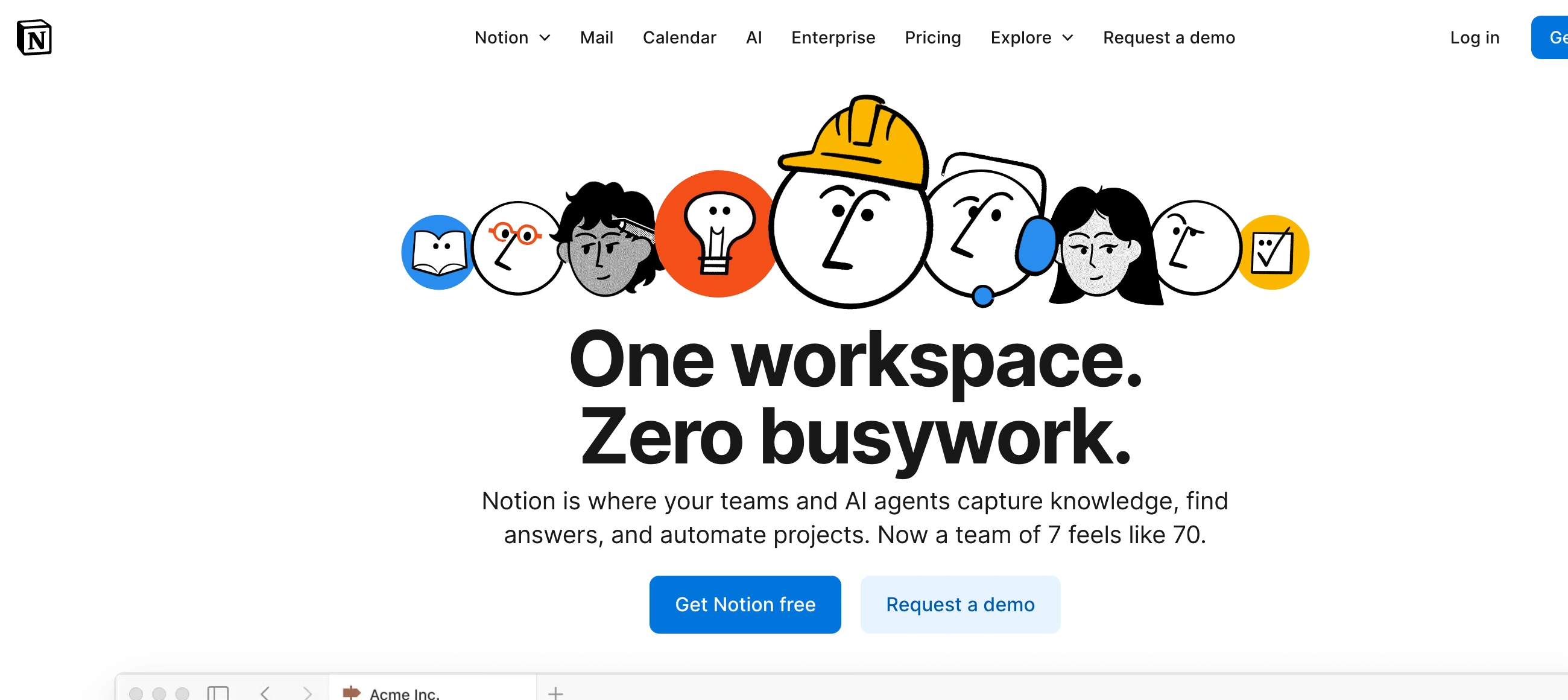
What it is: All-in-one workspace combining notes, wikis, databases, and project management in a block-based system you build from scratch or templates.
Best for: Content creators, startups under 50 people, knowledge workers who enjoy customizing their tools, and teams consolidating 3-5 fragmented apps.
Main limitation: 2-4 week learning curve before you're productive beyond basic notes, performance degrades with databases over 10,000 rows, and offline mode is severely limited compared to desktop functionality.
Get it if: You have time to build your perfect system, need flexible documentation that isn't just spreadsheets, and want one workspace for notes + tasks + databases without paying per tool.
Skip it if: You need plug-and-play project management (Asana wins), want robust offline access (OneNote wins), or lack someone who'll maintain the system (it becomes a content graveyard without a champion).
🎯 Why Notion?
Your team is juggling Google Docs for documentation, Trello for tasks, Airtable for databases, Evernote for notes, and Confluence for wikis. Five login passwords, five different interfaces, five places where critical information hides. Notion consolidates that chaos into one customizable workspace where everything links together and you stop playing "where did I save that?"
🧱 Block-Based Flexibility Beats Rigid Templates
Every Notion page is built from blocks—text blocks, heading blocks, database blocks, embed blocks, toggle blocks. Want a meeting notes page with embedded Google Calendar, linked task database, and collapsible sections? Build it. Need a product roadmap that's part Gantt chart, part wiki, part file repository? Done. One user: "I love that I can have a 'Tasks' database where one item is a simple checkbox, but clicking into it reveals a full project brief, a linked 'Client' database entry, and an embedded Figma file." This modularity means you're not fighting software that insists on its way—you shape Notion to match your workflow.
📊 Databases That Aren't Spreadsheets
Notion databases look like tables but act like databases with multiple views. Create a task database, then view it as a Kanban board for sprints, a calendar for deadlines, a gallery for design reviews, or a table for data analysis—all the same data, different perspectives. Filter by owner, status, or due date. Sort by priority. Link databases together so deals connect to companies, tasks connect to projects, and notes connect to meetings. It's the flexibility of Airtable without leaving your notes and docs.
🌍 6-7% Conversion Lift Through Localization
Notion's lifecycle team used localized onboarding campaigns for Korean and French markets, achieving 6-7% higher conversion rates compared to English-only messaging. When you personalize content in users' native languages within the same workspace, engagement jumps. Their feature adoption campaign hit 49-51% open rates and 1-1.5% click-through rates by targeting users based on personas and feature usage—numbers that beat industry averages because the messaging felt relevant instead of generic.
🎨 Free Plan That's Actually Usable
Unlike competitors that cripple free tiers, Notion Free gives individuals unlimited pages and blocks. Solo users can build sophisticated systems for personal projects, note-taking, or freelance work without paying. The catch? Add a second person and you hit a 1,000-block team trial limit, forcing upgrade decisions fast. For personal use though, it's genuinely one of the better free productivity tools available.

📈 What Notion Users Typically Achieve
Your Tool Sprawl Shrinks to One Login
Those 5+ tools you're juggling? They consolidate into Notion. Your team wiki moves from Confluence, tasks migrate from Trello, notes leave Evernote, lightweight databases come from Airtable, and documentation quits Google Docs. You're logging into one workspace instead of five browser tabs, eliminating the constant "where did I save that?" paralysis. One user documented replacing their entire creative workflow toolset into a single Notion workspace.
Conversion Rates Jump 6-7% Through Localization
Notion's lifecycle team saw 6-7% higher conversion rates when they sent localized onboarding in users' native languages instead of English-only messaging. If you're serving global customers, personalizing content in their language within the same workspace drives measurable engagement gains. Their feature adoption campaigns hit 49-51% open rates because messaging matched personas and usage patterns instead of generic announcements.
Onboarding Time Drops When Knowledge is Accessible
One G2 reviewer: "For me, the biggest benefit is clarity and continuity. I can document strategies, campaign logic, playbooks, and decisions in a way that new teammates can understand without constant handover meetings." When institutional knowledge lives in organized Notion pages instead of scattered emails and Google Docs, new hires ramp up faster because information is findable and contextual.
Meeting Notes Actually Get Referenced
AI meeting notes transcribe Zoom calls and generate summaries automatically. One user: "I often have content-heavy Zoom calls that I have to transcribe myself personally. This is extremely helpful in taking Zoom recordings and creating effective and concise meeting notes." Instead of notes sitting in someone's private notebook, they live in searchable Notion pages linked to projects, so context doesn't evaporate between meetings.
The Reality Check: It's a Content Graveyard Without a Champion
These wins assume someone on your team maintains the workspace. Without a designated Notion champion who updates templates, archives old content, and trains new users, the beautiful system you built becomes a ghost town. One user warns: "Teams build beautiful spaces that slowly turn into content graveyards because no one maintains them." Plan for 2-4 hours weekly of maintenance or watch adoption crater.
🛠️ How Notion Works
Think blank canvas meets LEGO blocks. You start with empty pages and build exactly what you need by adding blocks, creating databases, and linking everything together.
Setup: Templates vs Building From Scratch
Use a template to start fast—Notion offers hundreds for meeting notes, project trackers, wikis, CRMs, content calendars. Templates give you structure immediately. Or start with a blank page and add blocks one by one: headings, text, to-do lists, tables, databases, embeds. Most teams use templates for 70% of their needs, then customize aggressively. Setup time varies wildly—basic note-taking works day one, but building a multi-database CRM system takes 1-2 weeks even with templates because you need to understand database relations, views, and properties.
Daily Workflow: Living in Your Workspace
Open Notion to see your sidebar of pages—personal dashboard, team wiki, project boards, meeting notes. Click into today's tasks database filtered to show only your items. Update statuses by dragging cards between Kanban columns. Write meeting notes in a new page, @mention colleagues to notify them, link to related project pages. Embed a Google Doc or Figma file right in the page. Add comments for async discussion. The workflow feels fluid when your system is well-designed, chaotic when it's overcomplicated.
Database Views: Same Data, Different Lenses
Create one "Projects" database. View it as a table to see all fields at once. Switch to Kanban to track progress by status. Flip to calendar to see deadlines. Use gallery view for visual project overviews. Each view filters and sorts differently—show only active projects assigned to you in one view, all projects sorted by deadline in another. This multi-view flexibility means different team members can see the same data in the format that makes sense for their role.
Performance Reality Check
Small workspaces (under 1,000 blocks, databases under 1,000 rows) feel snappy. Medium workspaces (5,000+ blocks, databases with 5,000 rows) start showing lag when loading pages. Large workspaces (20,000+ blocks, databases over 10,000 rows) become noticeably slow, especially on mobile. Users consistently complain: "Performance can slow down with large or complex databases, causing delays and occasional lag." If you're building a CRM with 50,000 contacts, Notion will frustrate you. For documentation and moderate-sized databases, performance is acceptable.
⚙️ Core Features & What Actually Matters
📝 Pages & Blocks (The Foundation)
Everything in Notion is a page or a block. Pages nest infinitely—create a "Projects" page with sub-pages for each project, each with sub-pages for meeting notes, specs, and retrospectives. Blocks include text, headings, lists, tables, databases, embeds (Google Drive, Figma, Miro, Loom), code snippets, equations, toggles, and more. The flexibility means you build exactly what you need, but newcomers report: "Adding even a single block brings up a long scroll of options which can be confusing at first." Expect a week to feel comfortable with block types.
🗃️ Databases (Beyond Spreadsheets)
Databases are Notion's superpower. Create a "Clients" database with fields for company name, contact person, deal size, status, and linked contracts. View as table, Kanban, calendar, gallery, or list. Filter to show only active clients over $10K. Sort by deal size. Link to a "Projects" database so each client shows related projects automatically. The relational capability—linking databases together—enables sophisticated workflows without custom code. The limit? Databases over 10,000 rows get sluggish, and complex relations can confuse non-technical users.
🤖 Notion AI (Business Plan+ Only)
Full AI access requires Business plan at $20/user/month. Free and Plus tiers get a one-time 20-response trial—once it's gone, you're upgrading or going without. The AI summarizes notes, drafts content, translates languages, finds information across your workspace, and generates meeting notes from recordings. It's GPT-4 and Claude 3.7 Sonnet under the hood. One user: "I really like the new AI meeting note feature. I often have content-heavy Zoom calls that I have to transcribe myself personally. However, this is extremely helpful in taking Zoom recordings and creating effective and concise meeting notes." The catch? Notion doesn't publish AI usage limits, and heavy users report throttling after extensive use.
🔗 Integrations & Embeds
Embed Google Drive files, Figma designs, Loom videos, Miro boards, GitHub code, Typeform surveys, and 50+ other tools directly into pages. Two-way sync with Slack means updates in Notion post to Slack channels. Connect to Google Calendar for deadline visibility. The integrations eliminate constant tool-switching for basic workflows. However, you can't trigger complex automations—Notion's built-in automation is basic compared to Monday.com or ClickUp, so heavy automation users still need Zapier or Make.
👥 Collaboration & Permissions
Real-time editing works like Google Docs—see teammates' cursors, changes appear live. Comment on any block to discuss inline. @mention people to notify them. Permissions control who can view, comment, or edit each page. Business plan adds private teamspaces for sensitive content (HR docs, financial planning). The collaboration feels smooth for documents and light databases, but multiple people editing complex databases simultaneously can cause sync conflicts and lag.
📊 The Verdict: Our Assessment
8.9/10 - Notion delivers unmatched flexibility for building custom workspaces that consolidate notes, wikis, and databases. It stumbles on learning curve complexity, performance with large datasets, and locking AI behind expensive tiers.
The bottom line: Notion works brilliantly for knowledge workers, content creators, and startups under 50 people who have time to build and maintain custom systems. It fails for teams needing plug-and-play solutions (too much setup), mobile-first users (app lags desktop 6-12 months), and anyone managing massive databases (performance walls hit around 10,000 rows). The AI tier lockout—forcing $20/user/month Business plan for full AI access—feels like a bait-and-switch after years of offering AI as an $8 add-on.
💬 What Users Say: Reviews & Verified Experiences
User ratings: 4.7/5 on G2 (4,800+ reviews), 4.7/5 on Capterra (5,000+ reviews). High ratings reflect power users who mastered the system; casual users who bounce off the learning curve don't leave reviews.
👍 Pros: What Users Love
- Ultimate Flexibility: "I love that I can have a 'Tasks' database where one item is a simple checkbox, but clicking into it reveals a full project brief, a linked 'Client' database entry, and an embedded Figma file," says one Capterra reviewer. The ability to build exactly what you need—without software fighting you—drives long-term user satisfaction.
- Consolidates Multiple Tools: "I brought all of my creative work into one centralized place and as a result was better able to collaborate with my editors and researchers and better able to stay on track," reports one user. Teams consistently mention replacing 3-5 tools (Google Docs + Trello + Airtable + Evernote + Confluence) with Notion alone.
- Beautiful and Customizable: "I love how customizable Notion is and how easy it is to build exactly what you need. The templates help save time when creating pages, the database functionalities are getting much better, the integrations are quite powerful and the look is great (if you put a little effort in!)," notes a Capterra user. The clean interface and aesthetic appeal drive adoption even among non-technical users.
- Actually Free for Individuals: "I've been using Notion since 2022, and it has gradually become my main tool for managing tasks, data, and personal projects. I've built a habit tracker, a weekly planner, and even a game guide archive, all in one place," shares one reviewer. The generous free plan enables serious personal use without payment.
👎 Cons: Common Complaints
- Steep Learning Curve Understated: "The downside is that Notion can feel overwhelming for beginners. Adding even a single block brings up a long scroll of options; text, media, databases, and more which can be confusing at first. It definitely requires some patience to learn," warns one Capterra user. Multiple reviews mention 2-4 weeks before team members use Notion effectively.
- Performance Degrades With Scale: "Performance can slow down with large or complex databases, causing delays and occasional lag," reports one user. Another adds: "As workspaces grow, performance can slow down, and finding information can become difficult without strict organization." Teams managing 10,000+ database rows hit frustrating walls.
- Offline Mode is Broken: "This makes it difficult to use notion in remote areas with no internet connection," complains one Capterra reviewer. The mobile and desktop apps cache some content but many features require connectivity, making Notion unreliable for airplane work or remote locations.
- Becomes Content Graveyard Without Maintenance: "I have seen teams build beautiful spaces that slowly turn into content graveyards because no one maintains them," observes one G2 reviewer. Without a dedicated champion updating pages, Notion workspaces get stale and users stop checking them—then you're back to Slack chaos.
🚫 3 Critical Mistakes to Avoid
Mistake #1: Assuming AI is $8/Month Like the Old Days
One 15-person team budgeted $10/user/month for Plus plan + $8/user/month for AI add-on = $270/month total based on 2024 pricing. They discovered AI is now locked behind Business plan at $20/user/month minimum. For 15 people, that's $300/month—11% over budget. But the real shock? Business plan includes SSO and private teamspaces they don't need. They're forced to buy a feature bundle for the one feature they want. Over a year, that's $3,600 vs the expected $3,240 = $360 in surprise costs.
⚠️ Fix it: Know the new AI reality before trial: Full AI access requires Business plan at $20/user/month (annual) or $24/user/month (monthly). Free and Plus tiers get a one-time 20-response trial—period. If AI is essential, budget for Business tier immediately. Don't expect the old $8 add-on pricing. Calculate real annual cost: 15 users × $20/month × 12 months = $3,600/year for AI access. If you only need documentation and basic databases without AI, Plus at $10/user/month works fine. But if your team expects AI-powered summaries, meeting notes, and content generation, you're on Business tier or you're disappointed.
Mistake #2: Building an Overcomplicated System Nobody Maintains
One marketing team spent 3 weeks building an elaborate Notion workspace with 30 interlinked databases tracking campaigns, content calendars, client information, project status, budget tracking, meeting notes, and team wikis. Looked beautiful on launch day. Six months later, 60% of pages were outdated, databases had missing data, and the team reverted to Slack and Google Docs because nobody had time to maintain the complex system they built. The workspace became a content graveyard.
⚠️ Fix it: Start ridiculously simple—one database, one wiki structure. Launch that. Use it for 2-3 weeks. Then add ONE new component if genuinely needed. Resist the temptation to build everything at once. Designate a Notion champion (not just "whoever set it up") who owns maintenance: updating templates, archiving old content, onboarding new users, answering questions. Budget 2-4 hours weekly for this role. If nobody has 2-4 hours weekly, your system will rot. Better to have a simple system people actually use than a complex masterpiece that gets abandoned. Maximum rule: If your system requires more than 10 minutes of explanation to new users, it's overcomplicated. Simplify ruthlessly.
Mistake #3: Expecting Offline Functionality That Doesn't Exist
One consultant relied on Notion for client meeting notes and project documentation. Took a 6-hour flight with no WiFi to work on deliverables. Discovered Notion's offline mode only caches recently viewed pages—couldn't access 80% of their workspace, couldn't create new pages, couldn't edit databases. Six hours of planned productivity became wasted time because they assumed "desktop app" meant "works offline."
⚠️ Fix it: Know Notion's offline limitations before depending on it: Desktop and mobile apps cache recently viewed pages only. You can read cached content but editing is limited. Database functions barely work offline. New page creation doesn't sync properly. If you need reliable offline access, this isn't your tool—use OneNote, Apple Notes, or Obsidian instead. For airplane work or remote locations with spotty connectivity, export critical pages as PDFs before you go offline. Keep a backup system (Apple Notes, Obsidian, Notepad) for truly offline scenarios. Don't plan client presentations or important work sessions assuming Notion will function without internet—it won't. Test your specific offline needs during trial: turn off WiFi, try to do your actual work, and see what breaks. Plan accordingly.
FAQ
What is the learning curve for Notion?
Most users become productive within 1-2 hours of starting. Basic features are intuitive with in-app guidance, while advanced capabilities have comprehensive documentation, video tutorials, and customer support.
Does Notion integrate with my existing tools?
Notion offers 100+ native integrations covering popular CRMs, email platforms, analytics tools, and productivity apps. Additionally, Zapier connectivity and API access enable custom integrations.
What kind of customer support does Notion provide?
Email support is included in all plans with typical response times under 2-4 hours during business hours. Higher-tier plans include live chat support, priority response, and dedicated account management.
Can I migrate my existing data to Notion?
Yes, Notion provides data import tools supporting CSV files and direct migrations from major competing platforms. Migration support is available to help ensure smooth transitions with minimal disruption.
Is there a free trial or money-back guarantee?
Notion offers a 14-day free trial with full feature access and no credit card required. Most paid plans include 30-day money-back guarantees, allowing risk-free evaluation.
What security and compliance measures does Notion have?
Notion is SOC 2 Type II certified with end-to-end encryption, regular security audits, and GDPR compliance. Enterprise plans offer additional security features including SSO, advanced permissions, and audit logs.
Suggestly
Find your best-fit B2B tool in 90 seconds
✓ Free personalized recommendations
✓ Based on YOUR business needs
✓ No signup required

Notion