✨ Is Contentful Right for You?
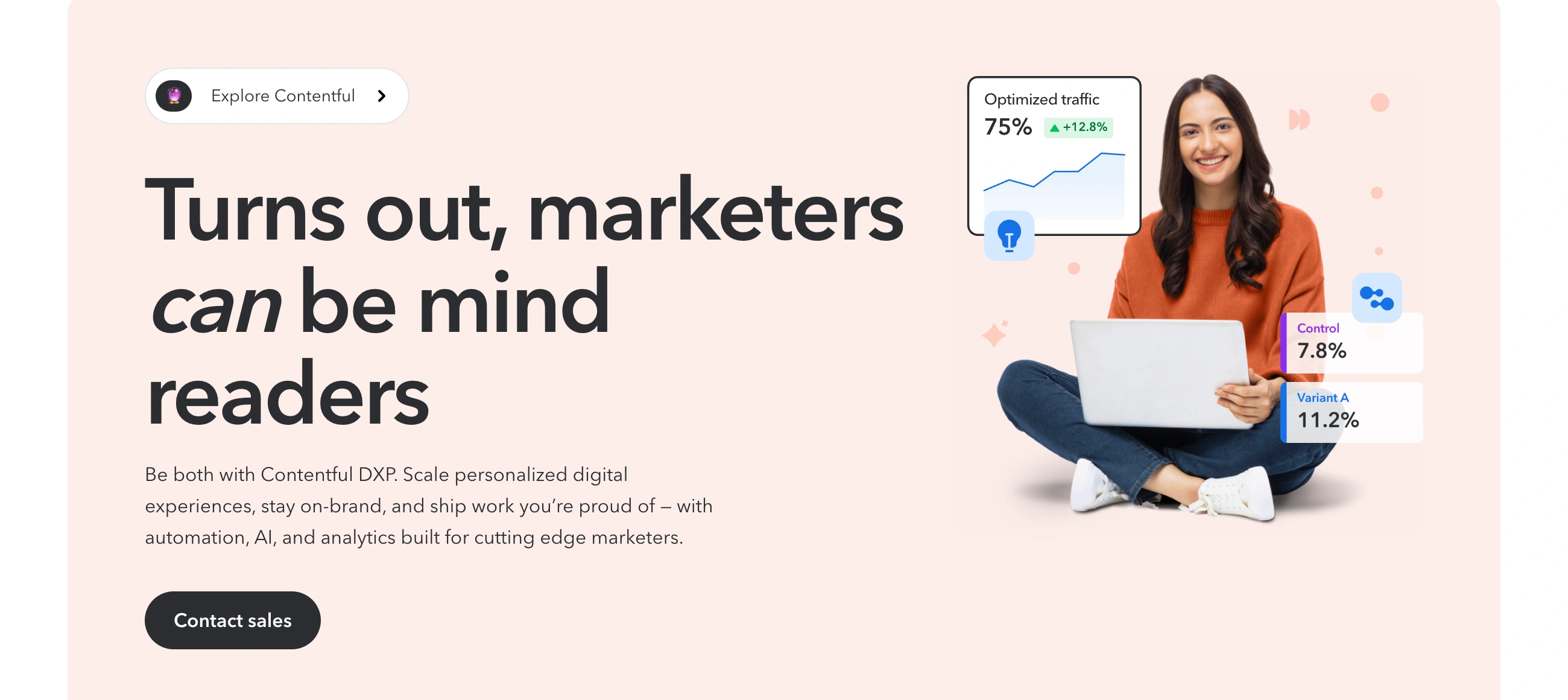
What it is: A headless CMS that separates content from presentation, letting you deliver the same content across websites, mobile apps, smartwatches, digital kiosks, and any other channel through APIs without rebuilding for each platform.
Best for: Enterprise teams managing content for multiple platforms, global companies needing multilingual delivery across 5+ channels, and developer-focused organizations building custom digital experiences where content powers websites, native apps, and IoT devices simultaneously.
Main limitation: Premium features like advanced localization, unlimited API calls, enterprise security, and multi-environment workflows require expensive tiers. The free plan works for testing, but real work starts at $300/month and scales to five figures annually once you add the spaces, bandwidth, support tiers, and marketplace apps enterprise teams actually need.
Get it if: You're delivering content to multiple channels simultaneously, your team includes developers comfortable with APIs and content modeling, and you need structured content that works everywhere without duplicating effort across platforms.
Skip it if: You're running a single website with non-technical editors, you need visual page building with live preview, or you want predictable low-cost pricing without usage-based surprises and hidden enterprise add-ons.
🎯 Why Contentful?
Traditional CMSes lock your content into rigid templates built for websites. Your mobile team needs different layouts. Your smartwatch app can't access it. Your in-store kiosks require separate content systems. Contentful breaks this by treating content as structured data that feeds any frontend you build.
🌐 Omnichannel That Actually Works
Create once, publish everywhere stops being a fantasy. A product description lives in Contentful. Your website pulls it via API. Your iOS app uses identical content. Your Android app, Apple Watch widget, digital signage, and voice interface all tap the same source. Update it once, everything updates within seconds. Fortune 500 companies run 30% of their digital operations through Contentful because content teams edit descriptions while developers never touch code and every channel stays synchronized.
⚡ Developer Freedom Marketers Can Use
Your developers choose their framework—React, Vue, Next.js, Svelte, whatever. Contentful doesn't care. It serves content through REST and GraphQL APIs with SDKs for JavaScript, Python, Ruby, iOS, Android, Java, and .NET. Frontend teams move fast while content teams work independently in the CMS interface. The separation matters when launching new channels. Adding a voice interface or AR experience? Your content is already accessible through APIs. No migration, no restructuring, just connect and pull data.
🌍 Global Content Without Localization Chaos
Managing content in 15 languages across 40 countries gets messy fast with traditional systems. Contentful's localization features let you create language-specific versions while maintaining relationships between entries. Your German product page links to German case studies automatically. Change the English version, and translators see exactly what needs updating in their workflow queue.

📈 What Contentful Users Typically Achieve
Your Multi-Platform Launches Get Faster
That new mobile app requiring separate content from your website? Not anymore. Teams report cutting multi-platform launch time by 40-60% because content lives in one place. Your content team creates entries once. Developers pull what each platform needs via API. iOS, Android, and web teams work simultaneously without waiting for content duplication. The time savings compound when you're launching across 5+ channels.
Content Updates Become Instant Everywhere
Update a product description in Contentful. Within seconds, your website shows the change. Your mobile apps pull the new content. Your smartwatch widgets update. Your in-store kiosks refresh. No more updating content separately in five systems and hoping nothing gets missed. One update, instant propagation across every touchpoint.
Global Teams Coordinate Without Email Chaos
Managing content in 15 languages stops being a coordination nightmare. Your English content team makes changes. Translators see exactly what needs updating in their workflow queue. German, French, Japanese, Spanish versions maintain relationships to the source content automatically. Teams report 50-70% reduction in translation coordination time and fewer inconsistencies between language versions.
Developers Ship Features Without Content Bottlenecks
Your frontend team wants to test a new feature. They don't wait for content—they pull it from Contentful's API and build. Content teams work in parallel, creating and updating entries without touching code. Development velocity increases because the content layer is completely decoupled. Feature releases that took weeks drop to days.
Traffic Spikes Don't Break Your Infrastructure
That viral moment or major product launch? Your content delivery doesn't sweat it. Contentful's global CDN handles the traffic spike automatically. Teams running sites with 1M+ monthly visitors report zero downtime during major traffic events. The infrastructure scales without your team doing anything.
🛠️ How Contentful Works
Contentful operates differently than traditional CMSes. Instead of page templates, you define content models—the structure of your data. Instead of WYSIWYG editors locked to HTML, you create reusable fields that feed any frontend.
Setup
Start by defining content types. A "Product" includes title (text), price (number), description (rich text), images (assets), and related products (references). An "Article" includes headline, author, body, categories, and publish date. These become your content building blocks that work across all channels. You create "Spaces" for different projects—one for your main website, another for your mobile app, a third for internal tools. Each Space contains its content models, entries, and assets with separate API credentials.
Content Creation
Content editors use Contentful's web interface to create entries. Fill in the fields you defined. Upload images to the asset library. Link related content through reference fields. The interface is clean but requires understanding your content model—there's no drag-and-drop page builder showing how it looks on the frontend. Real-time collaboration means your team sees who's editing what. Comments on specific fields let writers and editors discuss changes. Workflow states track content from draft through review to published without email chains or version control confusion.
Delivery
Here's where "headless" shines. Your content sits in Contentful's cloud. Your website, app, or digital display fetches it via API calls. Contentful delivers through a global CDN for fast loading worldwide—Tokyo, London, and São Paulo get identical sub-second response times. Developers query exactly the content they need using GraphQL or REST. No bloat, no unnecessary data, just the fields required for each screen. Updates happen in Contentful once. Within seconds, every connected channel shows the new content. No separate updates for mobile, web, smartwatches, and other touchpoints.
⚙️ Core Features & Performance
🎨 Content Modeling That Scales
Define exactly how your content is structured with custom content types and reusable components. The flexibility helps when managing complex relationships—products link to categories, articles reference authors, landing pages pull testimonials. You can nest content models seven levels deep for sophisticated architectures. The catch: poor content modeling creates messy systems later. Plan upfront or face painful restructuring with live content. Teams with solid information architects excel. Teams winging it struggle.
🔌 API-First Architecture
REST and GraphQL APIs give developers full control over data queries. Pull specific fields instead of entire entries. SDKs for JavaScript, Python, Ruby, Java, .NET, iOS, and Android speed up integration—most frameworks have plugins that handle the connection automatically. Webhooks trigger actions when content changes. Publish an article, rebuild your Next.js site automatically. Update a product, send notifications to your mobile app and Slack channel. The API architecture means fast responses—median 50-150ms globally through the CDN.
👥 Collaboration & Workflow
See who's editing what in real-time with presence indicators. Comment on specific fields for feedback without leaving the CMS. Version control tracks every change with rollback capabilities—undo that accidental deletion from three days ago. Workflow states move content from draft through review to published. Custom roles control who can create, edit, approve, and publish. The collaboration features work well for distributed teams, though advanced governance and approval workflows require Enterprise plans.
🌐 Global CDN & Asset Management
Images and videos deliver through Contentful's CDN with 99.99% uptime SLA on Enterprise. The image API resizes, crops, formats, and optimizes on-the-fly—request different sizes for mobile, tablet, and desktop without pre-processing. Good for performance, but bandwidth costs add up fast. Enterprise customers report $5,000-15,000 annual overages on high-traffic sites pulling lots of images. The asset organization is basic—folders and tags, no advanced DAM features without third-party integrations.
🔒 Security & Compliance
SOC 2 Type II certified. ISO 27001 compliant. GDPR and CCPA ready. SSO through SAML 2.0 on Premium plans. Custom roles and permissions let you restrict who accesses what content. API keys for different environments (development, staging, production). Two-factor authentication for user accounts. Audit logs track every change with timestamps and user attribution. For enterprises handling sensitive data, Contentful meets security requirements without additional configuration.
📊 The Verdict: Our Assessment
8.5/10 - Contentful delivers exactly what it promises: omnichannel content delivery through APIs at enterprise scale. Strong for multi-platform teams with technical resources, weaker on pricing transparency, learning curve for non-technical users, and native feature completeness.
Scoring Breakdown
What Contentful Does Exceptionally Well: If you need to deliver identical content to 5+ digital channels, Contentful's architecture is unmatched. The API-first approach gives developers complete freedom while content teams work independently. Global CDN performance is excellent. Enterprise security meets the strictest compliance requirements. The content modeling flexibility supports complex relationships and structures that traditional CMSes can't handle.
Where It Falls Short: Non-technical content editors struggle with the learning curve. The headless architecture means no visual preview of how content looks on the frontend. Pricing becomes expensive fast once you add the spaces, bandwidth, support, and marketplace apps enterprise teams need. Many features you'd expect native—translation workflows, advanced search, governance tools—require third-party integrations. The free and Team plans are genuinely limited for production use.
Who Should Choose Contentful: Enterprise teams with dedicated developers building multi-platform experiences. Global companies managing content in 10+ languages across multiple regions. Organizations where content powers websites, mobile apps, smartwatches, kiosks, and voice interfaces simultaneously. Companies with serious traffic (100K+ monthly visitors) needing proven scalability and 99.99% uptime.
Who Should Look Elsewhere: Single-website projects that need page builders. Non-technical teams without developer support. Small businesses on tight budgets wanting predictable costs under $500/month. Marketing teams that need visual editing and live preview. Anyone expecting comprehensive features without marketplace add-ons.
💬 What Users Say: Reviews & Verified Experiences
User ratings: 4.2/5 on G2 (300+ reviews), 4.5/5 on Capterra (63 reviews).
👍 Pros: What Users Love
- Content Works Everywhere: "The separation of content and presentation layer results in faster development," reports a Software Developer at a Maritime company. Multiple users appreciate delivering identical content to web, mobile, and other channels without duplication or inconsistency.
- Developer-Friendly APIs: "The API is feature rich allowing us to extend Contentful and tightly integrate it with our systems," shares an IT Project Manager at an Enterprise organization. The REST and GraphQL options with comprehensive SDKs give technical teams the flexibility they need.
- Handles Traffic Spikes: "The product is highly flexible, handling our peak traffic periods without any issues," notes a Senior IT Project Manager. The global CDN architecture scales when you need it—Black Friday, product launches, viral content—without performance degradation.
- Multi-Language Success: "The multiple language support has been incredibly useful, as we have a global audience and need to publish content in multiple languages," explains a CEO in Accounting. Managing translated content with maintained relationships between entries saves significant coordination time.
- Customization Options: "I love how Contentful customization options and managing content for multiple platforms with no stress changed my day-to-day," shares Kyeshuan H., a verified user. The flexibility to structure content exactly how your business needs it reduces workarounds.
👎 Cons: Where Users Hit Friction
- Non-Technical Users Struggle: "The learning curve can be steep for non-technical users initially," admits a Research Analyst in Education Management. The content model approach requires understanding data structure rather than just filling in a form, which confuses editors coming from WordPress.
- Pricing Becomes Expensive: "Pricing for premium features like advanced customizations and additional environments can get too costly," warns a Communications Manager in Maritime. What starts at $300/month scales to enterprise pricing faster than budget-conscious teams expect.
- Developer Dependency Persists: "You have to create custom fields in React, host them yourself and connect to the CMS manually," explains a frustrated user about customization limits. Despite the promise of content team independence, advanced features still require developer work.
- Preview Is Limited: "The preview feature is limited, so it's difficult to see what a page will look like before publishing," notes a Digital Marketing Specialist. This creates uncertainty when updating live content and makes editors nervous about breaking things.
- Missing Native Features: "There is no support for search integration on the frontend, this requires a third-party integration with potential additional costs," shares a Senior IT Project Manager. Translation workflows, advanced search, governance tools—enterprise teams expect these built-in but get marketplace apps with separate costs instead.
- Tutorial Gap: "I think their own tutorials to get started are not enough to get started, you have to look deeply to start developing there," reports a Software Developer. The documentation covers basics well but advanced use cases and migration strategies feel fragmented.
🚫 3 Critical Mistakes to Avoid
Mistake #1: Skipping Content Model Planning
One marketing team jumped straight into Contentful and started creating content types on-the-fly. Six months later, they had 40+ content types with inconsistent naming, broken relationships, and duplicate fields. Restructuring required migrating 10,000+ entries and rebuilding frontend queries. The project stalled for three months.
⚠️ Fix it: Map your content architecture before touching Contentful. Define content types, their relationships, and required fields on paper. Include your information architect, developers, and content leads in planning. Most successful implementations spend 2-3 weeks on content modeling before creating a single entry. Use Contentful's free plan to prototype your model with sample content before committing to production.
Mistake #2: Underestimating Total Cost of Ownership
A mid-sized company signed up for the Team plan at $300/month thinking they were set. Within four months, they needed additional Spaces ($pricing not public), hit bandwidth overages ($65 per TB), required Premium support ($19,000/year), and bought marketplace apps for translation management and advanced search. Their actual annual cost hit $52,000—17x their initial budget estimate.
⚠️ Fix it: Calculate your complete requirements before signing contracts. How many environments do you need? What's your monthly bandwidth usage? Do you need translation workflows, advanced search, or governance tools? Request detailed quotes that include all required add-ons. Most teams need Premium plans ($60K+ annually) for production use—don't fool yourself that Team plans scale beyond small projects. Factor in marketplace app costs and support tiers from the start.
Mistake #3: Assuming Content Teams Work Independently
A company chose Contentful specifically to "free content teams from developer dependencies." Six months in, content editors still needed developers for custom field types, preview configurations, complex workflows, and marketplace app integrations. The promised independence never materialized because the headless architecture requires technical expertise for anything beyond basic content entry.
⚠️ Fix it: Accept that Contentful requires developer resources. Budget for ongoing developer support—at minimum 5-10 hours weekly for a small team, 20+ hours for enterprise teams. Build custom apps and preview integrations upfront during implementation, not as afterthoughts. Train content teams on the content modeling approach with hands-on workshops, not just documentation. Set realistic expectations that content editors can create and update entries independently, but anything structural still needs developers.
FAQ
How much does Contentful actually cost for a real project?
The free plan works for testing but hits API limits and user restrictions fast. Real work starts at $300/month for the Team plan, covering small teams managing standard projects with enhanced editor tools and multiple spaces. Most small companies outgrow this within a year as content volumes increase. Mid-sized to enterprise teams land on Premium plans that list around $60,000 annually but negotiate down to roughly $37,600 median (negotiated discounts of 35-40% are common). Here's where costs escalate: additional Spaces for different environments (pricing not public but substantial), support tiers ($8,000 Silver to $35,000 Platinum annually), API bandwidth overages ($65 per TB above limits), and marketplace apps for features like translation management, advanced search, and governance tools. A fully configured enterprise setup with multiple spaces, platinum support, and necessary apps often hits $100,000-$200,000 annually. Most companies underestimate final costs by 2-3x when they first evaluate Contentful.
Can non-technical team members actually use Contentful?
Depends on your content model and team background. Content editors can create and update entries through the web interface once developers set up the content types. The interface is clean—fill in fields, upload images, link related content. But there's a real learning curve because you're working with structured data models, not page builders like WordPress. You need to understand how your content types relate, which fields are required, and how references connect entries. Teams coming from traditional CMSes report 4-8 weeks before editors feel confident. For simple updates (changing text, swapping images, updating prices), non-technical teams handle it fine after training. For anything structural (new content types, custom fields, complex workflows, integrations), you need developers. The headless architecture means you can't see how content looks on the frontend—preview features are limited. This uncertainty makes editors nervous about breaking things. Plan for ongoing developer support and invest in proper training workshops, not just documentation.
Does Contentful integrate with my existing tools?
Yes, through APIs and the marketplace. Contentful offers REST and GraphQL APIs plus SDKs for JavaScript, Python, Ruby, iOS, Android, Java, and .NET—developers can connect it to virtually any platform. The App Marketplace includes hundreds of integrations: Shopify for ecommerce, Netlify/Vercel for deployment, Algolia for search, Smartling for translation, Bynder for DAM, Cloudinary for image management, Salesforce for CRM, and Slack for notifications. Popular frameworks like Next.js, Gatsby, and Nuxt have plugins that handle SDK integration automatically. However, most integrations require technical setup—content teams can't just "turn on" an integration without developer configuration. Some features you'd expect native (advanced search, translation workflows, approval processes) require third-party apps that add costs. The extensibility is excellent if you have technical resources. Without developers, you're limited to basic built-in features.
How does Contentful compare to WordPress or traditional CMSes?
Completely different architectures. WordPress manages pages—you build layouts, add content directly to templates, publish complete pages. Contentful manages structured data—you define content models, create entries, then developers use APIs to display that data in any frontend framework. WordPress works for single websites. Contentful excels at omnichannel delivery where identical content feeds websites, mobile apps, smartwatches, kiosks, and voice interfaces simultaneously. WordPress has visual page builders and WYSIWYG editors with live preview. Contentful has no frontend—you can't see how content looks until developers build the presentation layer. WordPress costs $20-50/month for hosting plus plugins. Contentful starts at $300/month and scales to five-figure annual contracts. WordPress is easy for non-technical teams—install, pick a theme, start writing. Contentful requires developers to set up content models and build frontends. Choose WordPress when you're running a blog or marketing website and want simplicity. Choose Contentful when you're delivering content to multiple platforms, have dedicated developers, and need the flexibility of structured content accessible via APIs.
What are the main limitations I should know about?
Several catch teams off guard. First, the free plan is genuinely just for testing—you hit API call limits and user restrictions quickly with any real traffic. Second, premium features like advanced localization, unlimited API calls, enterprise security (SSO, custom roles), and multi-environment workflows require expensive Premium tiers starting at $60K+ annually. Third, many expected features aren't native—translation management workflows, advanced search, approval routing, and governance tools require paid marketplace apps or custom development. Fourth, preview is limited so editors can't easily visualize how content appears on the frontend before publishing. Fifth, all customization requires developer work—custom field types, UI extensions, and complex integrations need React/JavaScript expertise. Sixth, pricing becomes complex with usage-based charges for bandwidth overages ($65/TB), additional spaces (pricing not public), and support tiers ($8K-35K/year). Seventh, multi-environment publishing can be tricky—some configurations publish to all environments simultaneously, making testing difficult after going live. Finally, the learning curve for content modeling is steep for teams coming from traditional CMSes.
Is Contentful overkill for my project?
Probably yes if you're running a single website with a small non-technical team. Contentful makes sense when you're delivering content to multiple channels simultaneously—website plus mobile apps plus digital displays plus smartwatch apps plus voice interfaces. The architecture shines with omnichannel delivery where you need identical content accessible through APIs for different platforms. For straightforward websites, traditional CMSes like WordPress or simpler headless options like Sanity, Strapi, or Storyblok offer easier learning curves and more predictable pricing. Red flags Contentful is overkill: no developers on your team, managing a single website, need visual page building not APIs, budget under $500/month, content team is non-technical and prefers WYSIWYG editing, fewer than 10,000 monthly visitors, or launching in 3-6 months without technical resources. Green lights Contentful makes sense: building for 5+ platforms, have dedicated frontend developers, need structured content with complex relationships, managing content in 10+ languages, enterprise with serious traffic (100K+ monthly visitors), or Fortune 500 security/compliance requirements. The platform delivers on its promise of omnichannel content delivery, but only if you have the technical resources and budget to implement it properly.
Suggestly
Find your best-fit B2B tool in 90 seconds
✓ Free personalized recommendations
✓ Based on YOUR business needs
✓ No signup required

Contentful